Facebook
 Google
 GitHub
 Linkedin
NXP Intros Battery Cell Control ICs for EVs and Energy Systems
The family brings 18-channel monitoring and SPI-to-TPL bridge to electric vehicle and energy storage applications.
NXP Semiconductors has introduced the BMx7318/7518 family of battery cell controller ICs designed for high-voltage battery management systems in electric vehicles and industrial and residential energy storage systems.
These ICs bring an analog front-end, battery junction box, and gateway functions into a single device. The advanced architecture offers a flexible, cost-effective solution for improving battery management performance.
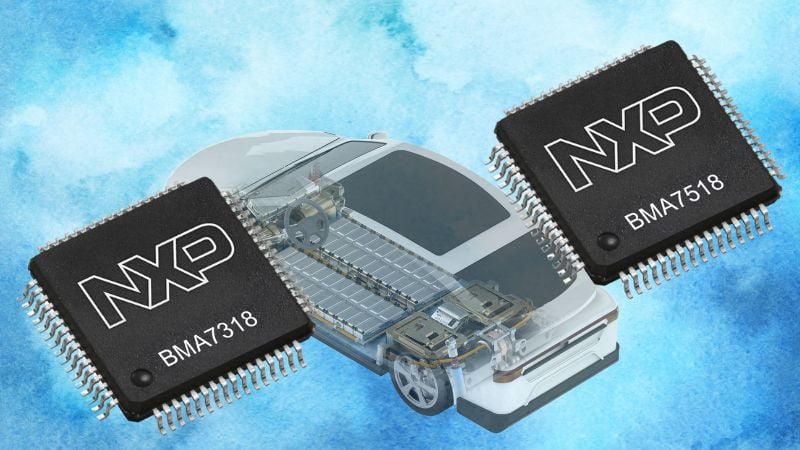
Battery cell controller ICs for electric vehicles and storage systems. Adapted from images used courtesy of NXP Semiconductors
The BMx7318
The BMx7318/7518 ICs are based on NXP’s updated battery cell controller architecture, which includes dedicated analog-to-digital converters (ADCs) per channel to eliminate crosstalk and enhance signal integrity. Each chip supports up to 18 lithium-ion cells, with cell voltage measurement accuracy of 0.8 mV and long-term drift minimized through ultra-low offset and gain errors (1 µV and 0.3%, respectively).
The design supports inductive and capacitive isolation daisy-chain communication. It includes an integrated SPI-to-TPL (transformer physical layer) bridge to offer designers communication flexibility across various automotive and industrial platforms. Current measurement is handled through external shunt sensing with configurable gain, covering a ±300 mV range. The IC provides up to 12 analog input channels for auxiliary voltage or temperature sensing.
Compared to previous products, battery balancing in the BMx7318 is enhanced through passive techniques with current capabilities up to 300 mA per channel and configurable via timer, voltage threshold, PWM, or temperature triggers. Notably, all 18 channels can balance simultaneously at 150 mA each, even at ambient temperatures up to 125°C.
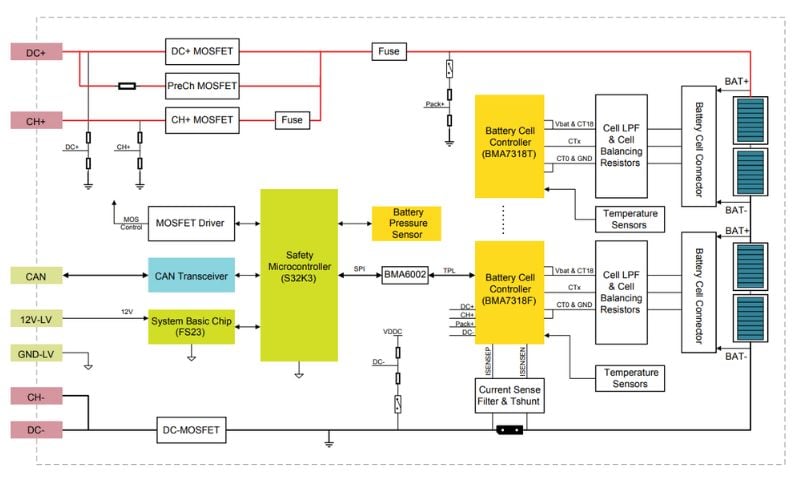
The BMx7318 block diagram. Image used courtesy of NXP Semiconductors
Overall, the IC family includes multiple variants, differentiated by communication interface (SPI or TPL), GPIO count, and temperature ratings, all packaged in 64-pin LQFPs. The ultra-low power mode (5 µA) also supports long-term storage and shipping requirements, and a dedicated hardware alarm pin ensures rapid fault detection in overcurrent scenarios.
Benefits of Channel Independence
Accurate voltage measurement is non-negotiable for battery management systems (BMS), as it directly affects state-of-charge calculations, safety protections, and balancing strategies. However, traditional architectures typically employ a single ADC multiplexed across multiple battery cells. While cost-effective, this approach introduces several limitations to signal interference or crosstalk. When such an ADC is switched rapidly between channels, it can degrade measurement fidelity and lead to erroneous cell data and suboptimal control decisions.
NXP's BMx7318/7518 IC family resolves these issues by integrating a dedicated ADC for each of its 18 cell inputs. This per-channel architecture eliminates the need for analog multiplexers and their associated switching delays. Each cell voltage is sampled simultaneously or in a tightly synchronized fashion, so time-varying electrical conditions across the battery pack are captured more accurately.
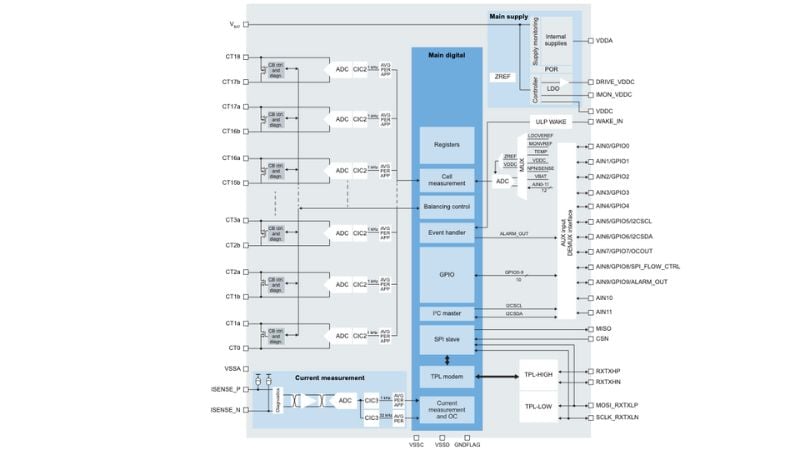
Block diagram. Image used courtesy of NXP Semiconductors
Additionally, dedicated ADCs reduce the impact of impedance mismatches and parasitic elements in the signal path, which are often exacerbated in multiplexed designs. The result is improved signal-to-noise ratio and greater immunity to electromagnetic interference. This architecture can simplify filter design since each channel has a consistent, non-interleaved signal path for tighter frequency response control and minimized need for external components.
Finally, parallel measurement can also enhance the accuracy of cell balancing. Effective balancing requires comparing all cells under similar load and thermal conditions. By capturing all cell voltages concurrently, the system avoids the temporal skew introduced by sequential sampling, which could otherwise misrepresent true inter-cell differences.
Expanding System Integration
As energy systems become increasingly distributed and software-defined, analog front-end ICs will be more instrumental to defining system behavior and safety. NXP’s approach of integrating sensing, control, and communication into a single platform hopes to position the BMx7318/7518 as a go-to solution for next-generation BMS designs. Samples are expected to be available in November 2025.