Facebook
 Google
 GitHub
 Linkedin
OpenGMSL Association Launches to Enable In-Vehicle GMSL Connectivity
Launching today, the organization aims to make GMSL technology a standard for automotive connectivity.
Today, Analog Devices has announced the formation of the OpenGMSL Association (OGA), a new non-profit consortium aimed at standardizing high-speed SerDes connectivity for automotive applications. To learn more about the goals of this consortium, All About Circuits spoke with Yasmine King, corporate vice president and head of the automotive business unit at Analog Devices.

GMSL as Closed IP
Analog Devices’ new initiative is built around GMSL, Analog Devices’ Gigabit Multimedia Serial Link technology, which has served as a proprietary solution for in-vehicle video and sensor connectivity since 2008.
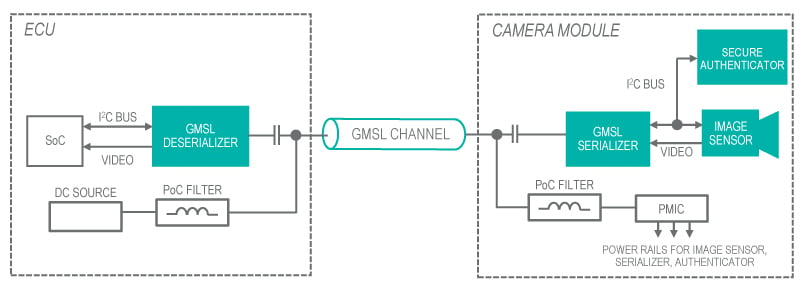
Communication using the GMSL channel's standard I2C bus.
Initially designed as a high-speed SerDes interface, GMSL enables video, control, and data to travel simultaneously over a single coaxial cable. It is mostly known for its robust PHY that supports ultra-low bit error rates over long cable lengths and offers compatibility across central compute units and edge devices. Its real-time link diagnostics allow pinpoint fault detection down to specific cable segments to improve serviceability and reliability.
Today, over one billion GMSL ICs are currently deployed on the road across more than 25 global OEMs and 50 Tier 1 suppliers. With this installed base and over 150 released components across three generations, GMSL has established a track record of field-proven performance for automotive, including an ASIL B rating.
OpenGMSL as an Industry Standard
The OpenGMSL Association takes GMSL from a proprietary protocol into a multi-vendor, globally accessible standard.
“Open GMSL Association is going to be an open worldwide standard that is leveraging the technology from GMSL,” King said.
A newly open specification, OpenGMSL includes over 200 pages of technical documentation, covering the full channel stack: physical and data link layers, protocol adapters, hardware register abstraction, configuration and status reporting, and both serializer and deserializer specifications. Additionally, OpenGMSL mandates a compliance certification process to ensure interoperability between all components from different manufacturers.
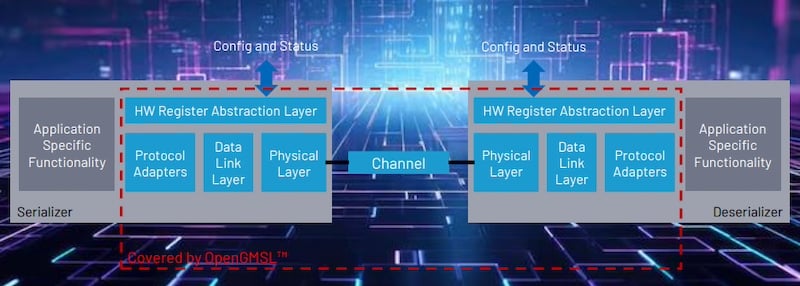
Mandatory compliance test certification program.
According to ADI, the OpenGMSL standard specifically focuses on edge connectivity, linking sensors and displays to zonal compute nodes in a modern software-defined vehicle (SDV) architecture. As OEMs migrate from domain-centric to zonal topologies, edge networks require low-power, low-latency, and asymmetric data handling. GMSL fits this need by consuming significantly less power than symmetric standards like Ethernet, which requires active links in both upstream and downstream directions even when only one direction transmits significant data, as is typical with sensors.
“Ethernet is a symmetric link. You have to send equal amounts of data upstream as you receive downstream,” King said. “But typically, when you're capturing data from an edge sensor, like a camera, it's mostly one way. Ethernet burns a lot of power because you're always powering both sides of the channel.”
ADI believes that GMSL’s asymmetry and efficiency make OpenGMSL a better match for high-speed, one-way data flows in next-generation architectures. The association also envisions future revisions of the standard to keep pace with growing ADAS complexity and AI integration at the edge. For example, current development efforts include embedding neural network processors at the edge to reduce reliance on central compute systems.
Broad Industry Buy-In
While several standards, such as MIPI A-PHY, ASA, and HSMT, are vying to address automotive edge connectivity, none currently match the maturity or adoption level of GMSL. According to Analog Devices, these alternatives remain in the early stages of deployment with no field-proven implementations in mass-market vehicles. OpenGMSL leverages a proven physical layer, robust electromagnetic compatibility (EMC) performance, and an existing component supply chain—advantages that will take years for newer standards to replicate.
To further bolster the standard, OpenGMSL Association already includes a diverse group of founding members spanning automotive OEMs, Tier 1 suppliers, semiconductor firms, and test and validation providers. Notable participants include Hyundai Mobis, Geely, Denso, Aptiv, Qualcomm, Omnivision, Ethernovia, Indie Semiconductor, and Globalfoundries. Ecosystem contributors include Granite River Labs, Teledyne LeCroy, Rohde & Schwarz, Keysight Technologies, and Würth Elektronik.
An Industry-Wide Bet on Interoperability and Scale
OpenGMSL is ultimately about enabling design freedom while reducing the barriers to scale. The automotive industry’s shift toward SDVs requires fast iteration cycles, resilient supply chains, and standards-based architectures that prevent vendor lock-in.
“I am strongly convinced that this industry will not succeed in the transition to SDV unless we take a step forward and show we can collaborate more strongly across the industry, across all different players in the ecosystem,” King said. “I'm really excited about this. I'm so passionate about making sure this is successful.”
All images used courtesy of Analog Devices. Featured image used under Canva Pro license.
Related Content