Facebook
 Google
 GitHub
 Linkedin
Polyn Implements Its NASP Tech Into Voice Activity Detection Chip
The company’s first silicon-proven NASP device delivers microwatt-level, real-time voice processing at the sensor edge.
Polyn Technology has announced the first silicon-proven implementation of its Neuromorphic Analog Signal Processing (NASP) technology. Realized in a voice activity detection (VAD) chip, the new product confirms that Polyn’s analog neuromorphic design flow can translate trained digital neural models directly into manufacturable silicon.
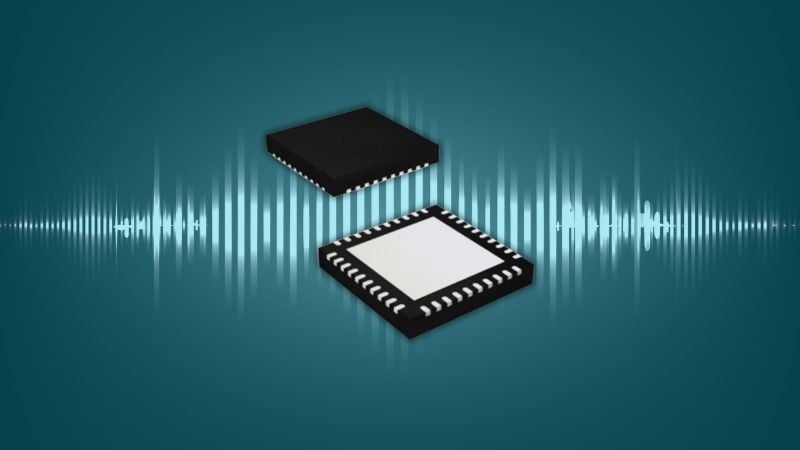
Polyn's NeuroVoice Voice Activity Detection (VAD) chip.
What Is NeuroVoice VAD?
NASP, first introduced in early 2025, is a hybrid analog-digital architecture that executes neural inference in the analog domain. By mimicking biological neural computation, it processes sensor signals natively, eliminating the power and latency penalties associated with digital conversion.
The first fully implemented VAD chip, dubbed NeuroVoice VAD, is an application-specific standard product (ASSP) designed to detect human speech from microphone input. Polyn Technology built the system on the NASP architecture, where it performs analog-domain inference to determine whether a voice is present. In this paradigm, the chip only triggers data transmission when needed. Compared to traditional, continuous-sensing solutions, NeuroVoice VAD’s event-driven behavior reduces system-level energy use in always-on devices such as earbuds and acoustic monitors.
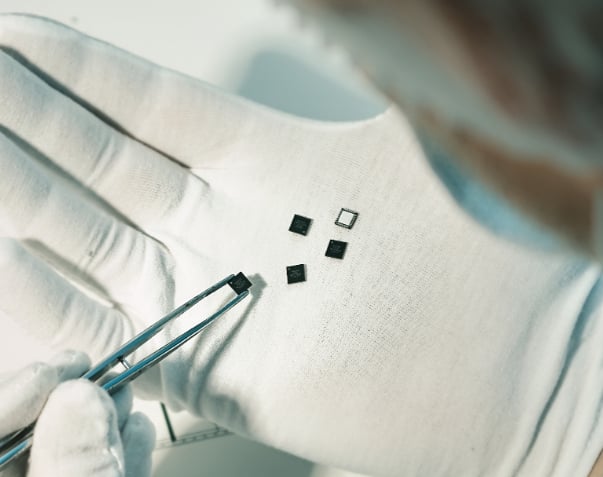
NeuroVoice VAD chips.
Fabricated in a 90-nm CMOS process, the chip integrates an asynchronous analog neural core that operates without a clock or ADC/DAC conversion. It achieves ultra-low latency of 50 microseconds per inference and continuous operation at approximately 34 µW. The NASP core extracts feature embeddings directly from the analog microphone signal, virtually eliminating front-end digitization overhead and unlocking sub-millisecond response to speech events.
The device also features PDM and I2S interfaces that support multiple bit depths and sampling rates (16 kHz or 48 kHz), along with SPI and I2C control channels for configuration and monitoring. A programmable clock reset unit accepts an input of up to 24.576 MHz and supports automatic power down when idle. Its 5 mm x5 mm QFN package houses analog and digital supply domains at 1.2 V and I/O at 1.8 V.
Neuromorphic Analog Signal Processing
Neuromorphic analog signal processing applies neural-network principles to continuous electrical signals rather than digitized samples. Each “neuron” in the network corresponds to an analog computation node, typically composed of operational amplifiers and resistor-based synapses that encode learned weight values.
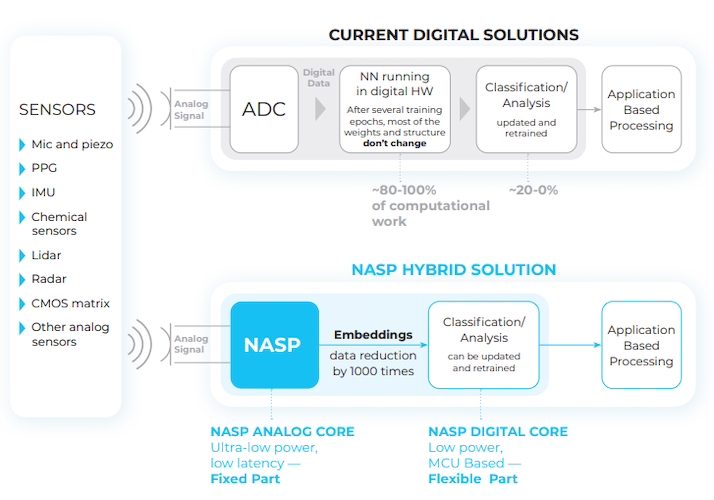
NASP versus current digital solutions.
In a NASP-style architecture, signal features (such as amplitude modulations or spectral shifts) are transformed in real time by these analog neuron arrays. Because computation occurs before digitization, the approach eliminates costly sampling and quantization steps. The result is energy use in the microwatt range and latencies measured in tens of microseconds, far below those of conventional digital TinyML implementations.
Such architectures are inherently event-driven. Rather than processing continuous streams, they respond only to meaningful signal changes. In a voice detection context, this means that analog neurons minimize dynamic power by remaining quiescent until they detect acoustic patterns resembling speech.
From Proof of Concept to Edge Deployment
Polyn validated the NASP synthesis toolchain and the hardware core’s analog neuron array, reporting that the silicon test results matched the modeled behavior of its analog neural compiler. The company plans additional cores for speaker recognition and voice extraction, leveraging the same tool-assisted conversion from digital training data to analog layouts.
Evaluation kits for the NASP VAD chip are available on Polyn’s website, with general ordering expected to follow CES 2026.
All images used courtesy of Polyn Technology.