Facebook
 Google
 GitHub
 Linkedin
Qualcomm Ruggedizes New Processors for Industrial PCs at the Edge
The chips are Qualcomm's first industrial-grade PC processors built for PLCs, panel PCs, and edge controllers with support for Windows.
Qualcomm is extending its reach further into industrial computing with the launch of the Dragonwing IQ-X processor series, a new family of rugged SoCs built to handle demanding real-time workloads in harsh environments.
The IQ-X line arrives in two SKUs, the 12-core IQ-X7181 and the 8-core IQ-X5121, both based on Qualcomm’s Oryon architecture, with up to 3.4 GHz per core and up to 45 TOPS of on-device AI via an integrated Hexagon NPU.

The IQ-X line is purpose-built for industrial environments.
Designed to survive a temperature range of -40 °C to 105 °C, and offering up to 64 GB of LPDDR5X memory, the series brings modern compute features like USB4, PCIe Gen4, Wi-Fi 7, and up to six cameras into a footprint and power envelope suited for field equipment, embedded vision nodes, industrial gateways, and SCADA platforms.
Built for the Factory Floor
Most modern edge processors borrow from mobile or data center DNA. Qualcomm leans into that mobile heritage here with the IQ-X, but adds industrial discipline with a rating for extended temperature, high I/O density, and 10+ year longevity through Qualcomm’s product lifecycle program. That makes it deployable not just in edge servers, but in panel PCs, DIN-rail gateways, and fanless enclosures riding the side of a robot arm.
The design starts with the Oryon CPU, a custom 64-bit core tuned for deterministic performance, paired with an Adreno GPU for visualization and a Hexagon NPU for local AI inference. The CPU hits 3.4 GHz in a single core, a figure aimed squarely at control loops, real-time data logging, and other latency-sensitive workloads that traditional multicore systems often struggle to prioritize. Multithreaded performance is scalable across 8 or 12 cores, depending on the model, while the NPU handles computer vision and embedded machine learning tasks without needing a dedicated AI accelerator card.
Thermal constraints are handled by design; the SoCs are passively cooled, low-profile (under 3-mm package height), and pin-compatible with standard FC-BGA substrates. That keeps board-level integration straightforward for OEMs used to building with discrete SoCs and FPGAs, but looking to consolidate functionality.
A Full Stack for Edge-Native AI and HMI
Where traditional embedded processors offer basic video and touchscreen support, the IQ-X series is built to handle industrial HMIs and vision systems natively. The IQ-X7181 supports up to four 4K displays (via DisplayPort 1.4a and embedded DisplayPort), dual ISPs with 36 MP support, and 4K/120 video decode with AV1 and VP9. Even the lower-end IQ-X5121 can drive multiple displays and camera inputs concurrently.
This makes the platform viable not just for basic automation panels, but for vision-based quality inspection, augmented operator UIs, remote control interfaces, and mobile diagnostic systems. Developers can wire in RGB + IR cameras, stream video locally or over the network, and apply AI models for defect detection or situational awareness, all on a single chip.
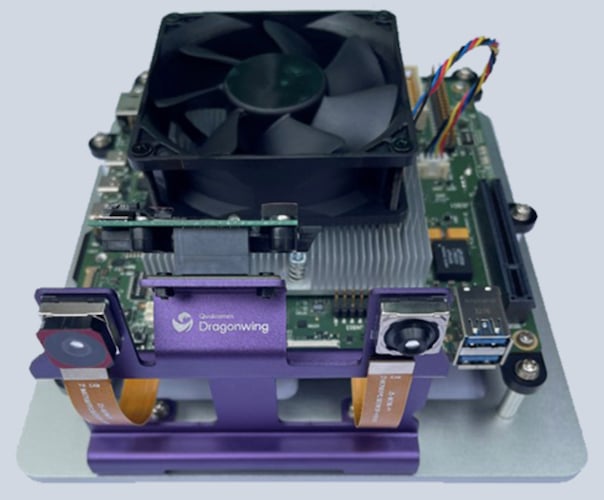
Qualcomm has also released a Dragonwing IQ-X EVK for development.
AI processing is handled by the integrated Hexagon NPU, which reaches 45 TOPS of compute without relying on external silicon. That headroom is more than sufficient for common AI workloads at the edge, such as object detection, anomaly scoring, gesture recognition, or NLP-based voice control.
The I/O list seems to meet the checklist for modern workloads:
- Up to 16 PCIe lanes for high-speed expansion
- USB4 for modern peripherals and docked systems
- UFS 4.0 and SD Express for local storage
- Up to six camera inputs, including dual 36-MP sensors
- Wi-Fi 7, 5G, and Ethernet via M.2 or companion chip
All of this is housed in a 58 mm x 58 mm BGA package, with 221 GPIOs and support for UART, SPI, I2C, and I3C through Qualcomm’s QUP interfaces. Software compatibility includes Windows LTSC, which keeps deployment friction low for integrators with legacy software stacks or offline operational requirements.
Applications That Push the Edge
Qualcomm is positioning the IQ-X series as a clean replacement for both x86-based IPCs and modular edge compute systems built around multicard stacks. That means targeting everything from industrial robots to AI gateways to transportation control units.
Qualcomm also calls out use cases in smart transportation, such as rail systems, automated forklifts, or mobile workstations, as well as power and utilities, where rugged edge compute is critical for substation monitoring and SCADA interface systems. Longevity and wide temperature support make the chips suitable for pole-mount, rack-mount, or vehicular deployment.
What all of these use cases share is a need for flexibility at the edge: the ability to run traditional workloads, vision tasks, and AI models simultaneously, without pushing power budgets or relying on active cooling.
All images used courtesy of Qualcomm.