Facebook
 Google
 GitHub
 Linkedin
Radia Perlman: The Engineer Who Made Networks Work
Perlman revolutionized both internet routing and Ethernet, transforming the latter from a few hundred nodes in a single building into large networks with thousands of computers.
In this final installment of Women's History Month spotlights, we celebrate Radia Perlman, a computer programmer and network engineer who changed how computers communicate. Her work made networks scalable and self-healing, helping shape the foundation of modern internet infrastructure. She designed the Spanning Tree Protocol (STP), improved network security, and wrote textbooks that clarified complex concepts for engineers.

Radia Perlman, the inventor of STP. Image used courtesy of the National Inventors Hall of Fame
Early Life and Education
Perlman was born in 1951 in Portsmouth, Virginia, and grew up in New Jersey. Her parents were engineers, but she didn’t fit the typical profile of a tinkerer. She was more interested in music, art, and writing than taking apart electronics. In high school, she took a programming course at Stevens Institute of Technology but found it unwelcoming, with her classmates often using jargon she didn’t understand.
Perlman eventually enrolled at MIT and studied mathematics. While taking a physics class, a teaching assistant asked her if she’d like to be a programmer for a project he was working on. Although Perlman didn't know how to program, she quickly learned and later expressed that programming was like composing music—logical and structured but also creative.
MIT, TORTIS, and Developing STP
As an undergraduate at MIT, Perlman worked in the LOGO Lab, developing a programming system for young children called TORTIS (Toddlers Own Recursive Turtle Interpreter System). It used physical buttons instead of keyboards, allowing children as young as three to control a robot turtle.
The system removed syntax barriers and helped kids focus on sequencing and logic. She observed that children learned best with minimal adult interference, a principle she later applied to networking: systems should work intuitively without requiring constant human intervention.
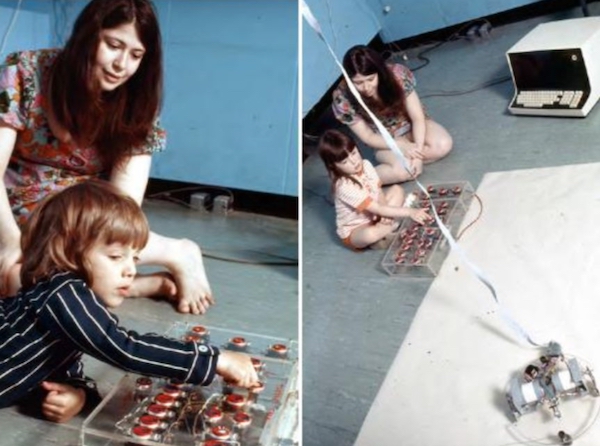
Perlman observes children using the TORTIS Button Box circa 1974–76. Image used courtesy of Radia Perlman and Retro Computing
For her PhD at MIT, she focused on making networks resilient against malicious disruptions. Her thesis proposed self-stabilizing algorithms that allowed networks to recover from failures or attacks without manual intervention. This idea became a key part of secure distributed systems, including blockchain technology.
In the 1980s, Ethernet networks had a major problem. Adding redundancy for reliability caused broadcast loops that crashed systems. Working at Digital Equipment Corporation (DEC), Perlman was asked to solve this issue. In a single night, she designed the Spanning Tree Protocol (STP), an algorithm that prevented loops by selectively blocking redundant paths. The result: a network that could expand without breaking.
STP became an industry-standard in 1990 (IEEE 802.1D) and is still used today, though later protocols like TRILL improved on it by allowing more efficient routing. Perlman described STP in a short poem: “A mesh is made by folks like me. Then bridges find a spanning tree.” She also helped develop IS-IS, a routing protocol that scaled well for large networks and was widely adopted by internet service providers.
Contributions to Networking Education
Perlman wrote “Interconnections” in 1992, a clear and practical guide to networking. Unlike other textbooks, it avoided unnecessary jargon and focused on the concepts engineers needed. It became the go-to reference for bridge, router, and protocol design. She also co-authored “Network Security” in 1995, explaining cryptographic principles in an approachable way. As an adjunct professor at Harvard and the University of Washington, she emphasized simplicity in design and troubleshooting and encouraged students to think critically rather than memorizing technical details.
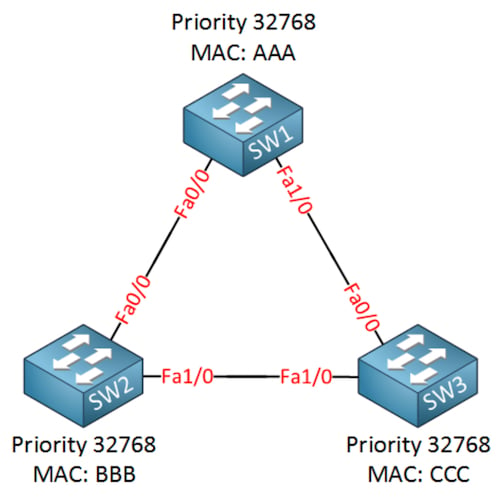
Example of the STP in action. Here, the protocol helps to create a loop-free topology by blocking certain interfaces. Image used courtesy of Network Lessons
Perlman has received numerous awards, including the Internet Hall of Fame in 2014 and the U.S. National Inventors Hall of Fame in 2016. She holds over 100 patents in networking and security. Today, she works at Dell Technologies, refining network protocols and challenging conventional thinking about blockchain and public key infrastructure.
Despite her influence, she dislikes being called the “Mother of the Internet,” a moniker some have used to praise her accomplishments. She sees networking as a collaborative effort and believes her work, while significant, was part of a larger system of innovations.
Featured image used courtesy of Canva Pro, Wikimedia Commons (CC by 3.0), and the National Inventors Hall of Fame.