Facebook
 Google
 GitHub
 Linkedin
Renesas Keeps Automotive Displays Sharp With New LCD Video Processor
The dual-channel LCD video processor mitigates frozen video, incorrect colors, and broken or corrupt video images that could obstruct a driver’s view of the road.
Many modern drivers now expect features that go beyond navigation, safety alerts, and driving assistance. These may include heads-up displays (HUDs), digital instrument clusters, and camera monitoring systems (CMS). These systems, however, are highly susceptible to issues like frozen video, distorted images, and signal interference.
Renesas recently launched the RAA278830, a dual low-voltage differential signaling (LVDS) LCD video processor, to address these problems.
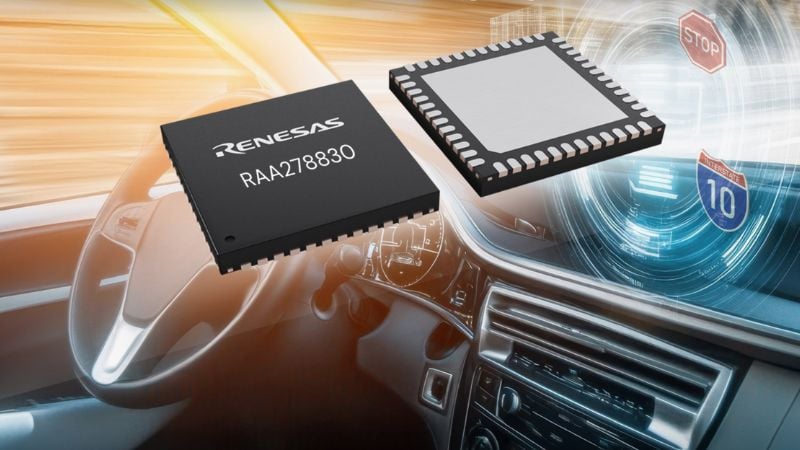
Renesas' LVDS solution adds ISO 26262 compliance to its video diagnostic features.
Designed for safety-critical automotive display systems, the RAA278830 provides essential video diagnostics and signal integrity checks to prevent visual anomalies that could endanger drivers. Compatible with HUDs, digital instrument clusters, and CMS, it keeps display systems operational, even in the face of potential faults, which can help prevent driver distraction and improve overall vehicle safety.
Features to Prevent Corrupted Display Systems
The RAA278830 (short-form datasheet linked) supports two open-LDI inputs with 150 MHz per channel. It is fully compatible with VESA and JEIDA display formats, making it versatile enough for a wide range of automotive applications. Built-in diagnostics can detect issues like frozen video, incorrect color rendering, and corrupted video images. The RAA278830 also meets ISO 26262 ASIL B functional safety standards, ensuring the processor's reliability in mission-critical automotive systems. Integrated safety mechanisms, such as CRC, parity checks, and built-in self-test (BIST), continuously monitor signal integrity to minimize the risks of display errors during critical driving moments.

Block diagram of the RAA278830.
Many automotive displays require multiple discrete components for video signal management and diagnostics. The RAA278830 integrates these key functions into a single chip, ensuring the reliability of the automotive system. The IC incorporates features such as an image enhancement engine, spread spectrum technology for lower electromagnetic interference, and multiple diagnostic engines, making it easier for manufacturers to develop and deploy high-performance display systems.
The New LCD Video Processor in Action
Renesas designed the RAA278830 to enhance the safety and reliability of automotive display systems across a variety of applications. In HUDs, for example, its diagnostic capabilities safeguard critical driver information, such as speed or navigation instructions, against corruption.
In digital instrument clusters and CMS, the processor keeps vital information, such as vehicle speed, fuel levels, and camera feeds from side mirrors, accurate and visible. The chip's support for both bitmap and font-based on-screen displays (OSD) allows manufacturers to offer flexible, customizable display options, improving the user experience. Its multi-bank fail-safe over-the-air (OTA) update capability also ensures the longevity of automotive displays, enabling manufacturers to push software updates without requiring service visits.
Safety will always be a critical concern in the automotive industry. The RAA278830 may be a valuable tool for maintaining accurate and clear visual information. Renesas claims the RAA2278830 Video Diagnostic Bridge IC’s robust platform can monitor signal integrity and image quality to help automakers build safer, more reliable vehicles.
All images used courtesy of Renesas.
Related Content