Facebook
 Google
 GitHub
 Linkedin
Renesas Releases Magnet-Free Inductive Position Sensors and Design Tool
Renesas has added three magnet-free inductive position sensor ICs and a web-based coil design tool, offering a cleaner alternative to magnetic and optical encoders.
While position sensing has long relied on magnetic and optical encoders, both bring familiar problems. Magnets pull in dust and metal shavings, and optical encoders need exact alignment and regular cleaning. In tough factory environments, those issues cause extra maintenance and unexpected stops. Many engineers now look for something simpler and tougher that can still measure position with the same accuracy.
Renesas is addressing that need with a new lineup of inductive position sensor ICs built around non-contact coil technology.

Designers can customize the new magnet-free inductive position sensors for various coil designs for industrial applications such as robotics, healthcare, smart buildings, home appliances, and motor commutation.
The RAA2P3226, RAA2P3200, and RAA2P4200 cover a range of motion types and speeds, giving system designers a flexible replacement for bulky magnetic or optical encoders. The device's sense position is determined through printed copper coils and a metal target, eliminating magnets entirely.
How the Inductive System Works
Each sensor generates and measures small electromagnetic fields through its coil set. When a conductive target moves across the coils, it changes the inductance, and the chip translates that shift into an exact position. Because the coils are part of the PCB and there’s no physical contact, the system resists dust, vibration, and high temperatures. It also avoids stray-field interference, a major limitation for magnet-based sensors.
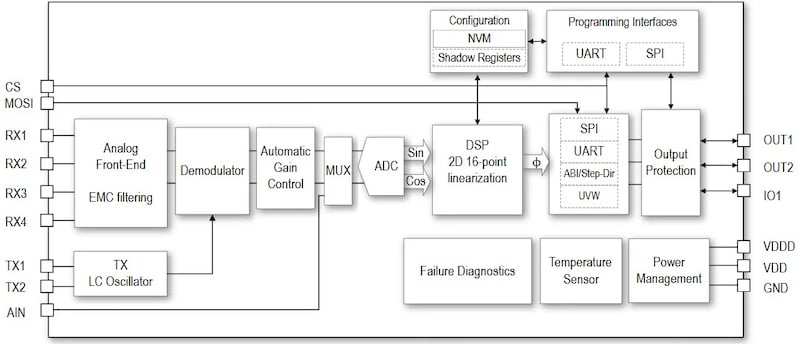
Block diagram of Renesas’ RAA2P3200 inductive position sensor IC, illustrating its signal path and interface architecture.
The sensors operate across the full -40°C to 125°C industrial range and maintain accuracy better than 0.1% of full scale. They can measure rotary, linear, or arc motion, supporting both on-axis and off-axis layouts. With no moving electronics or optical paths to clean, long-term drift and wear are minimal, cutting service needs in continuous-use machines.
Inside the Three New Devices
The RAA2P3226 (datasheet linked) serves high-precision robotic and industrial automation systems. It supports dual-coil sensing for up to 19-bit resolution and 0.01° absolute accuracy, plus a propagation delay below 100 ns at electrical speeds up to 600,000 rpm. Interfaces include UART, I²C, ABI, and Step-Dir. Built-in automatic gain control maintains accuracy as air gaps change.
The RAA2P3200 (datasheet linked) focuses on high-speed motor commutation in e-bikes and cobots. It runs at the same 600,000-rpm electrical speed with short latency, offering SPI, UART, ABI, UVW, or Step-Dir outputs. Over-voltage, reverse-polarity, and short-circuit protection simplify integration into drive systems where reliability is critical.
For lower-speed work such as medical equipment or power tools, the RAA2P4200 (datasheet linked) uses a simpler single-coil setup. It outputs analog, PWM, or I²C signals and retains the same environmental endurance and automatic calibration features. All three devices share a 3.0 V to 5.5 V supply range and 16-point linearization to fine-tune precision at the system level.
Real-World Fit and Applications
The new ICs slot naturally into motor drives, actuators, and valve controls, as well as service robots and smart-building systems. Their coil-and-target structure tolerates moisture, vibration, and metallic interference that often disable optical sensors. In rotating machinery, the ability to handle hundreds of thousands of electrical revolutions per minute allows direct mounting on shafts without extra gearing.
For designers shifting away from legacy encoders, the devices reduce total bill-of-materials cost and simplify packaging. The sensors’ low power draw and robust signal chain also support compact embedded boards used in healthcare or portable automation gear.
Web-Based Design Tool
To make the move to inductive sensing easier, Renesas released the Inductive Position Sensor Coil Optimizer, a browser-based design environment that automates coil creation. Users pick a device, motion type (rotary, arc, or linear), and configuration template, then run a simulation that models inductance, voltage levels, and predicted linearity error. The tool provides 3D visualization and exports Gerber files ready for PCB fabrication.
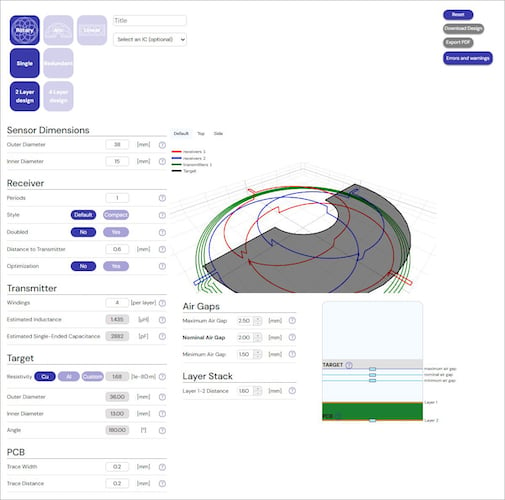
Renesas’ Inductive Position Sensor Coil Optimizer, a web-based tool for designing and simulating custom coil layouts.
Engineers can test single, dual, or redundant coil setups inside a personal workspace on the MyRenesas portal, compare multiple simulations, and store past runs for reference. The result is faster prototyping with fewer iterations, letting teams tune the sensor geometry without deep RF expertise.
A Maintenance-Free Solution in Harsh Conditions
By pairing fast inductive sensing with an easier design process, Renesas offers engineers a real alternative to encoders that can’t handle harsh conditions. The sensors hold up against heat, vibration, and stray magnetic fields, making them a good fit for factory machines, robots, and new smart-infrastructure systems that need accurate, maintenance-free feedback.
All images used courtesy of Renesas.
Related Content