Facebook
 Google
 GitHub
 Linkedin
Research Finds 30% More Power in EV Batteries
Addressing cathode degradation causes could make next-gen electric vehicle batteries more stable and longer lasting.
Electric vehicles and other applications need higher-capacity and more efficient lithium-ion batteries. Lithium-rich oxides have gained attention as potential cathode materials because they can store more energy. However, issues such as capacity loss, voltage fading, and structural instability have posed challenges for widespread use.
Researchers from the College de France and the University of Montpellier are offering new insights into cathode degradation that could make EV batteries more powerful.

EV battery. Image used courtesy of Adobe Stock
Degradation in Lithium-Rich Cathode Batteries
With specific capacities exceeding 250 mAh g⁻¹, lithium-rich oxides are promising cathode materials for next-generation batteries. This superiority in performance is facilitated by oxygen redox (O-redox) reactions. For example, as described in the Nature study, during the initial charge cycle, Li₁.₂Ni₀.₁₃Co₀.₁₃Mn₀.₅₄O₂, O²⁻ oxidizes to molecular O₂, disrupting the honeycomb transition metal, ordering and forming vacancy clusters that trap O₂ within the particle. By the first cycle’s end, trapped O₂ is fully reduced back to O²⁻, enabling reversible O-redox capacity. However, with continued cycling, the O-redox mechanism evolves and becomes less reversible.
Increasing O₂ accumulation at discharge indicates incomplete reduction during subsequent cycles, which ultimately results in capacity loss. Additionally, reduced O₂ trapping at charge suggests oxygen escape from the structure. Collectively, these factors lower O-redox-derived capacity from 55% in cycle 2 to 34% by cycle 100.
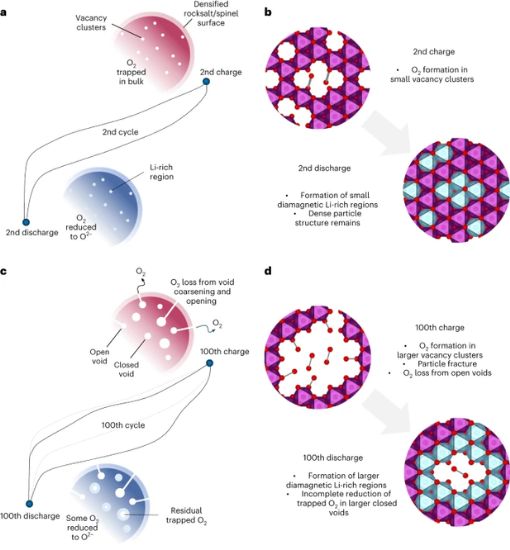
The voltage fade mechanism. Image used courtesy of Marie et al.
Furthermore, microstructural degradation exacerbates performance loss. Reports using STEM, ptychography, and small-angle scattering confirm void formation in Li₁.₂Ni₀.₁₃Co₀.₁₃Mn₀.₅₄O₂, while broader studies link Li-rich NMC to particle cracking due to lattice strain. The increasing density of large voids filled with O₂ weakens particles and causes fractures that facilitate O₂ release from exposed voids and equals loss over extended cycling.
The Real Origin of O2 in Lithium-Rich Cathodes
Another study in Nature challenged the long-standing assumption that molecular oxygen formation is the primary cause of degradation in lithium-rich cathode materials. Researchers found that previous conclusions were likely skewed by the experimental conditions, particularly X-ray analysis. Their findings suggest that O₂ detected within the cathode was an artifact of the testing process rather than a fundamental degradation mechanism.
The study provides researchers with a new direction. Instead of focusing on preventing O₂ formation, they are now directing efforts toward stabilizing "structural oxygen," where oxygen atoms remain within the cathode’s crystal structure but undergo oxidation during cycling. This shift in approach aims to enhance battery longevity by addressing structural integrity rather than mitigating irreversible oxygen loss. The study also highlights the importance of integrating theoretical modeling with experimental data to validate material behaviors.
Future Directions in Battery Research
Lithium-rich cathodes can store around 30% more energy than modern lithium nickel manganese cobalt oxide (NMC) cathodes. As battery technology advances, refining material stability and efficiency will remain a priority for researchers. Future studies will likely focus on engineering cathode compositions that mitigate oxygen loss while maintaining high energy density. If successfully implemented, these advancements could improve the viability of lithium-rich batteries to meet broader electrification goals.