Facebook
 Google
 GitHub
 Linkedin
RLC Roundup: New Passives Push Power, Frequency, and Temp Limits
New passive components from TDK, Vishay, Murata, and Bourns address higher capacitance, RF power handling, automotive power circuits, and high-temperature operation.
TDK, Vishay, Murata, and Bourns have introduced four new passive component families covering capacitors, inductors, and resistors. The releases range from a 10-μF, 100-V multilayer ceramic capacitor to high-frequency chip resistors that can operate at up to 50 GHz.
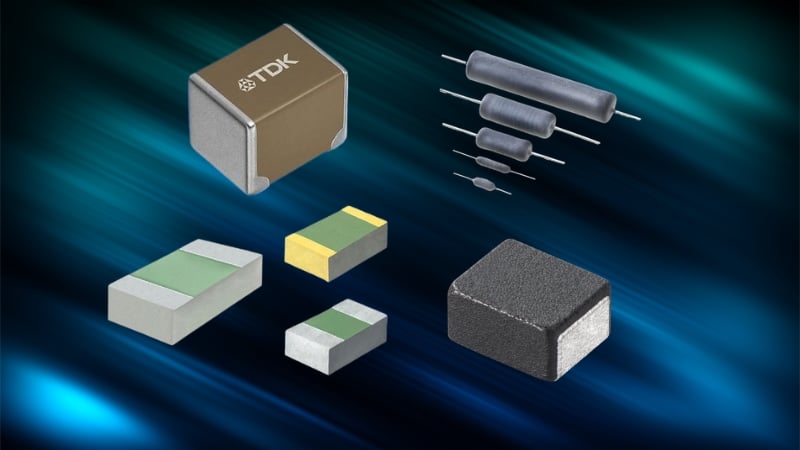
The components address different circuit requirements, but size and power handling come up throughout the releases. TDK is targeting 48-V power lines, Vishay is increasing the power small RF resistors can handle, Murata has added more inductance options for automotive power circuits, and Bourns is addressing resistors used in high-temperature automotive environments.
TDK Increases Capacitance in 100-V MLCCs
TDK has expanded its CN series of low-resistance, soft-termination MLCCs with a 10-μF, 100-V X7R capacitor in a 3225, or EIA 1210, package. Measuring 3.2 mm × 2.5 mm × 2.5 mm, the new capacitor is available as the automotive-grade CNA6P1X7R2A106K250AE and commercial-grade CNC6P1X7R2A106K250AE. The automotive version is AEC-Q200 qualified.
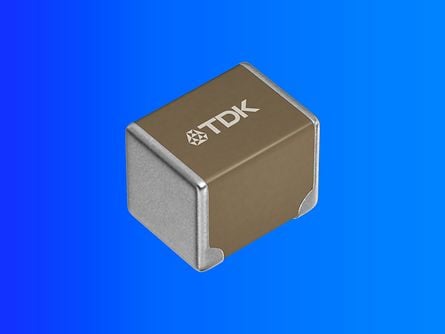
TDK’s CN series soft-termination MLCCs provide 10-μF capacitance and a 100-V rating in a compact 3225 package. Image used courtesy of TDK
The 10-μF capacitance is significant because TDK says it is twice that of its previous capacitors at the same size and voltage rating. This lets engineers use fewer MLCCs for smoothing and decoupling on 48-V power lines, reducing both component count and mounting area. TDK also uses an optimized resin electrode structure for soft termination, which helps protect the ceramic against cracking from mechanical stress while keeping terminal resistance comparable to its standard-termination products. Applications include AI servers, humanoid robots, xEVs, and industrial equipment.
Vishay Raises Power Handling in 0402 and 0603 Resistors
Vishay's new Sfernice CHEP series includes thin-film, high-frequency resistors in 0402 and 0603 case sizes. The CHEP0402 carries a standard 1.2-W rating, with up to 1.8 W possible under the additional mounting conditions specified in the datasheet. The CHEP0603 is rated at 2 W and can reach 2.8 W under those conditions.
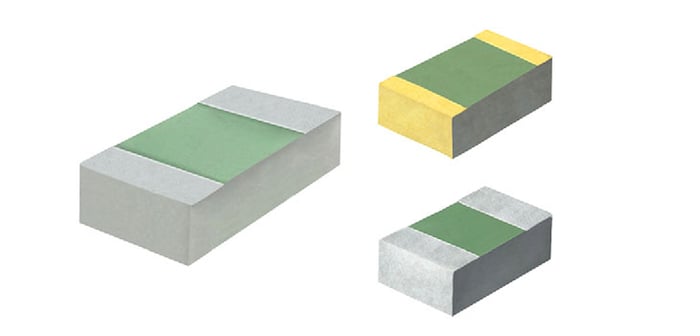
Vishay’s CHEP thin-film chip resistors provide high power handling and operation up to 50 GHz in compact 0402 and 0603 packages. Image used courtesy of Vishay
That power handling comes from an aluminum nitride substrate combined with heat dissipation through the PCB, eliminating the need for active cooling. The resistors are also built to minimize internal reactance, with LC values down to 1 × 10⁻²⁴. Flip-chip versions of the 0402 devices operate at frequencies up to 50 GHz, while 0603 devices reach 40 GHz. Resistance values range from 20 Ω to 120 Ω. Vishay is targeting RF applications including 5G and 6G infrastructure, LEO satellites, antennas, data links, and phased-array radar.
Murata Expands Automotive Power, Inductor Range
Murata has recently added nine inductance values to its DFE2MCPH_JL series of automotive-grade metal power inductors. These nine new inductors extend the available range from 0.10 μH to 4.7 μH while maintaining a compact 0806-inch (2.0-mm × 1.6-mm) footprint.

Murata’s DFE2MCPH_JL metal power inductors offer multiple inductance values in a compact 2.0-mm × 1.6-mm package for automotive power circuits. Image used courtesy of Murata
More inductance values give engineers more options for matching components to different power-supply requirements in ADAS, in-vehicle infotainment, and other automotive electronics. The series combines low DC resistance with high current capability and a 40-V withstand voltage. For example, the new 0.10-μH version has a maximum DC resistance of 0.010 Ω and a rated current of up to 11.1 A based on inductance change. All of the devices are AEC-Q200 compliant for automotive use.
Bourns Adds High-Temperature Wirewound Resistors
Bourns has introduced its UT-A series of power wirewound resistors for automotive and other high-temperature power applications. The series covers power ratings from 1 W to 10 W and resistance values from 10 Ω to 4.5 kΩ, with ±1% resistance tolerance available as standard. The resistors also have a standard temperature coefficient of ±30 ppm/°C.

Bourns’ UT-A Series wirewound resistors provide 1-W to 10-W power ratings for the automotive industry. Image used courtesy of Bourns
The UT-A series operates from -55°C to +150°C and is AEC-Q200 compliant. Those specifications matter most for automotive circuits near power conversion equipment, powertrain components, and braking systems, where elevated temperatures can be part of normal operation rather than a short-duration event. The AEC-Q200 qualification also gives engineers an automotive-specific reliability baseline when selecting components for these systems. Construction includes a ceramic core, flame-resistant silicone coating, and welded terminations, while the wirewound element provides pulse handling for transient loads.
New Targets Across the Passive Market
Overall, the four releases address different parts of passive component selection. TDK is adding capacitance to a 100-V MLCC, Vishay is increasing RF resistor power handling in small packages, Murata is offering more inductance options for automotive power circuits, and Bourns is extending wirewound resistor operation to 150°C.