Facebook
 Google
 GitHub
 Linkedin
Interview—R&S Shares Details About Its New Compact 8 Channel Oscilloscope
In this exclusive interview, we learn how the new MXO 3 series provides high-speed acquisition, 12-bit resolution, and "industry-leading" analysis tools in a small form factor.
Rohde & Schwarz has launched its new MXO 3 series oscilloscopes, expanding the company’s next-generation MXO portfolio with compact four- and eight-channel models. To learn more about the new scope, All About Circuits had an exclusive interview with Elizabeth McKenna, RSNA Product Manager at Rohde & Schwarz.

The compact MXO 3 series measures 375 mm wide and 163 mm high.
Building on the same high-speed MXO technology that powers the MXO 4 and MXO 5/5C lines, the MXO 3 delivers the same signal fidelity and analysis performance in a smaller, more affordable instrument class. Available in bandwidths from 100 MHz to 1 GHz, the new models aim to democratize testing by catering to a wide range of test environments with low bench footprint and cost.
MXO 3 Oscilloscope Technology
The MXO 3 (product brochure linked) measures 375 mm wide and 163 mm high, and includes an 11.6-inch full-HD capacitive touchscreen and an intuitive SmartGrid interface. With these features, the MXO 3 provides layout customization and multi-domain analysis in a form factor that fits most benches.
The MXO 3 is built around Rohde & Schwarz’s MXO-EP application-specific integrated circuit (ASIC), which processes 400 Gbit/s to accelerate all waveform operations in hardware. The device features ASIC-powered hardware acceleration that delivers an industry-leading acquisition rate of 4.5 million waveforms per second and up to 99% real-time capture.
McKenna explained how the new MXO 3 fits into the history of the MXO series. “When we introduced the MXO 4, we introduced the brand new hardware, the MXO-EP ASIC,” she said. "That ASIC is the back-end chip that supports the MXO 4. MXO 5, MXO 5C, as well as now the MXO 3.”
“What's really fascinating about the MXO 3 is that, for the first time, we're bringing this custom and performance hardware down to this class of scope that has traditionally been in that cost-optimized space,” said McKenna, “Those cost-optimized scopes use off-the-shelf parts, but here we’re actually using our R&S-developed back-end ASIC chip, while also introducing an eight-channel product.”
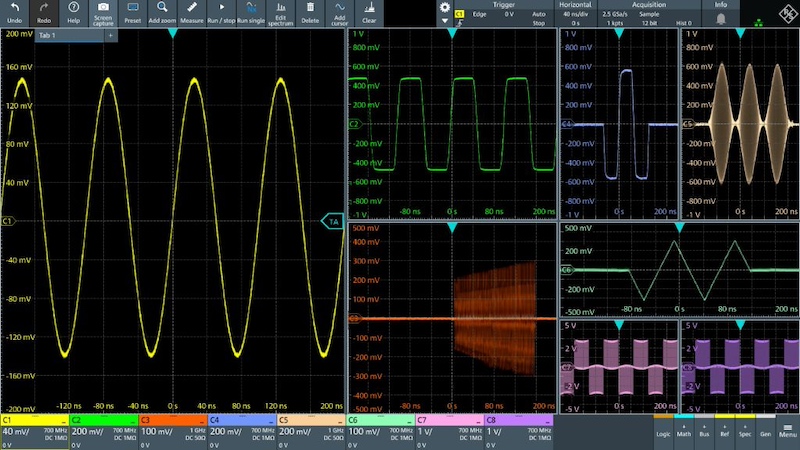
Using all eight channels on the MXO 3.
With a digital trigger architecture that achieves less than 1 ps of trigger jitter and a minimum re-arm time of 21 ns, the series supports up to 600,000 trigger events per second through zone triggering, and 50,000 FFTs per second for high-speed frequency-domain analysis.
Each model also features a 12-bit analog-to-digital converter (ADC) at all sample rates, with 16x the resolution of standard 8-bit oscilloscopes. An 18-bit high-definition mode offers even greater visibility into low-level signals by combining digital filtering and hardware-level precision without sacrificing speed. The instrument’s deep 125 Mpoints of memory per channel is expandable to 500 Mpoints and maintains full sample rate performance for long acquisitions.
Other integrated options include a 50 MHz arbitrary waveform generator, 16-channel mixed-signal analysis (MSO), and serial bus decoding.
Digital Trigger Architecture
Digital triggering is one of the more impactful developments in oscilloscope design in the past fifty years.
Traditional analog triggers rely on separate signal paths for acquisition and triggering, which can introduce offset errors, jitter, and limitations in trigger sensitivity. Digital trigger systems, by contrast, sample and apply mathematical interpolation to integer data directly from the ADC output. With a more unified approach, digital triggering unlocks lower jitter, finer sensitivity, and more stable operation across temperature and bandwidth variations.
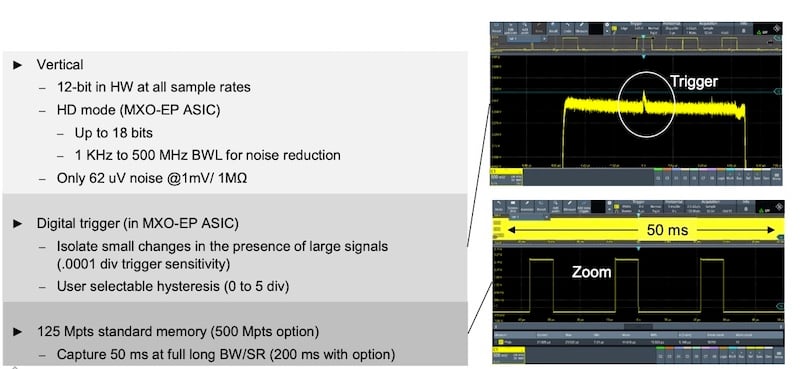
Digital triggering capability in the MXO 3 means you can isolate small changes in the presence of large signals.
Modern digital triggers, such as those found in high-end oscilloscopes, often include adjustable digital filters that apply noise reduction directly to the trigger path. In this way, the instrument can trigger on signals close to the noise floor and capture events as small as fractions of a millivolt. The trigger sensitivity allows engineers to detect subtle transitions that older analog systems might ignore. Combined with programmable holdoff and advanced modes like pulse width, runt, and slew rate triggers, digital trigger systems help testing engineers isolate virtually any signal behavior of interest.
Digital triggers are particularly pertinent in applications like serial bus decoding or power integrity analysis, as they improve detection accuracy and support correlation with time-aligned math or logic signals. As a result, digital triggers improve measurement repeatability and diagnostic efficiency.
Zone Trigger
McKenna went into detail about what she says is probably her favorite feature on the MXO. zone trigger. “This is basically graphically triggering or graphically isolating an event,” she said. “You can draw the trigger. It doesn’t have to be a rectangle. It can have up to eight different points on it. Then you can combine multiple zones and say ‘this signal must or must not intersect these zones”, or ‘it must do this one and this one.’ “
“Using the zone trigger, you can do a lot of Boolean algebra to figure out what scenario makes the most sense. But it's a really impressive capability. And it’s done in hardware.”
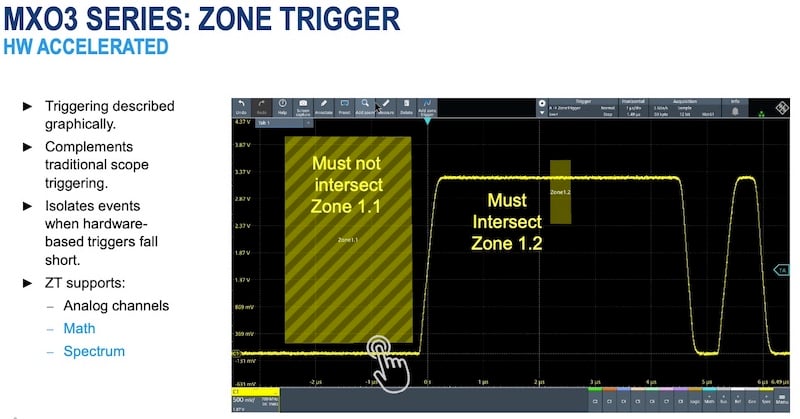
The zone trigger feature enables you to set up your triggering graphically so you can graphically isolate an event.
Compact Power With Broader Access
As part of the All About Circuits Summit Series 2025 virtual event in October, Rohde & Schwarz provided an on-demand webinar that dives into detail about the company's whole MXO product family. The webinar gives a detailed walkthrough of the MXO architecture and concludes with the first live reveal of the MXO 3 oscilloscope, its design, and capabilities. You can watch the webinar on-demand here. The MXO 3 series is available now through Rohde & Schwarz and distribution partners.
All images used courtesy of Rohde & Schwarz.