Facebook
 Google
 GitHub
 Linkedin
Semiconductor Fabs Announce New Plans to Rebalance Capacity and Control
Recent fab announcements highlight how manufacturers are translating long-term roadmaps into physical capacity.
Texas Instruments, Onsemi, IonQ, and Micron have each advanced major manufacturing initiatives over the past several weeks, spanning new fab production starts, process partnerships, vertical integration, and greenfield construction.
The announcements include Texas Instruments beginning 300-mm wafer production at its Sherman, Texas, site, and Micron breaking ground on a new advanced NAND facility in Singapore. Onsemi and GlobalFoundries are also aligning on GaN power devices, while IonQ is moving to acquire U.S. foundry operator Skywater Technology.
Texas Instruments Begins 300-mm Production
Texas Instruments has started production at SM1, the first of four planned 300-mm fabs at its Sherman, Texas mega-site, marking a transition from construction to volume manufacturing. The company says the fab is already shipping devices to customers and is designed to ramp toward tens of millions of chips per day as capacity is filled.
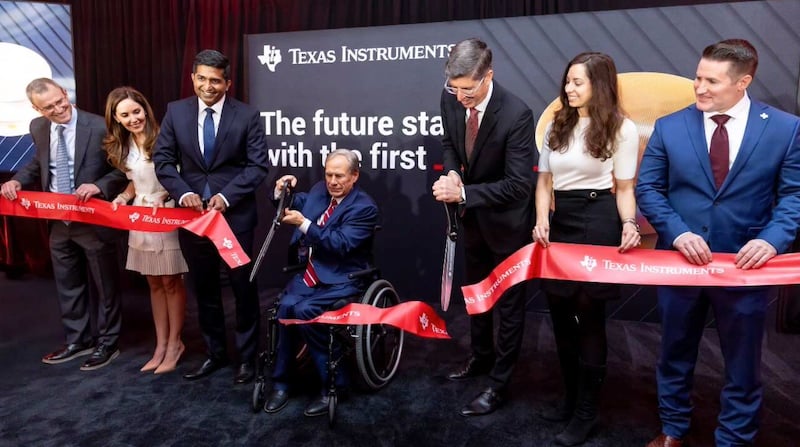
TI President and CEO Haviv Ilan, Texas Governor Greg Abbott, and others celebrate the ribbon-cutting ceremony at TI’s new Sherman semiconductor fab. Image used courtesy of Texas Instruments
The Sherman site is central to TI’s long-term manufacturing strategy. Across its Sherman, Texas; Richardson, Texas; and Lehi, Utah sites, the company has outlined more than $60B in U.S. fab investments, with up to $40B allocated to Sherman alone. SM1 is focused on 300-mm analog and embedded processing.
The devices coming out of Sherman are expected to span TI’s core portfolio: power management ICs, signal chain devices, microcontrollers, and mixed-signal components used across industrial automation, automotive electronics, and infrastructure equipment. Moving these products to 300-mm wafers reduces the cost per die and gives TI tighter control over supply in markets where customers value longevity and predictable availability.
Onsemi and GlobalFoundries Align on 200-mm GaN Power
Onsemi and GlobalFoundries (GF) have announced a partnership to develop next-generation GaN power devices, starting with 650-V lateral GaN built on GF’s 200-mm enhancement-mode GaN-on-silicon process. The companies expect customer sampling in the first half of 2026.
The agreement adds a foundry-backed manufacturing path to Onsemi’s wide-bandgap portfolio, complementing its internal SiC investments. Meanwhile, for GlobalFoundries, it advances a differentiated specialty process offering as more customers look beyond silicon MOSFETs for efficiency gains. Using 200-mm wafers is a key point, allowing GaN to benefit from mature silicon tooling and higher throughput than 150-mm lines, improving cost and scalability.
The partners will aim the initial 650-V devices at high-efficiency power conversion. Data center power supplies, AI accelerator racks, telecom infrastructure, and certain automotive systems all benefit from GaN’s higher switching speeds and reduced losses. As power density rises in these systems, lateral GaN offers designers a way to shrink magnetics and improve overall efficiency without moving to higher voltage classes.
GaN has proven its advantages, but consistent, high-yield manufacturing remains a barrier for broad adoption. By anchoring development on a qualified 200-mm platform, Onsemi and GlobalFoundries are attempting to move GaN closer to a repeatable, volume-ready power technology rather than a niche solution.
IonQ to Vertically Integrate With Skywater Technology
IonQ’s agreement to acquire Skywater Technology is unusual in that it brings a quantum computing company directly into the semiconductor manufacturing business. The transaction, valued at roughly $1.8B, would make IonQ the owner of a U.S.-based foundry with trusted manufacturing credentials.
Quantum hardware development is constrained by iteration speed, yield learning, and packaging integration, not just qubit design. By owning Skywater, IonQ gains direct access to fabrication, process development, and advanced packaging without the delays that come from negotiating external foundry cycles. Skywater will continue to operate as a subsidiary, serving existing customers while also supporting IonQ’s internal roadmap.
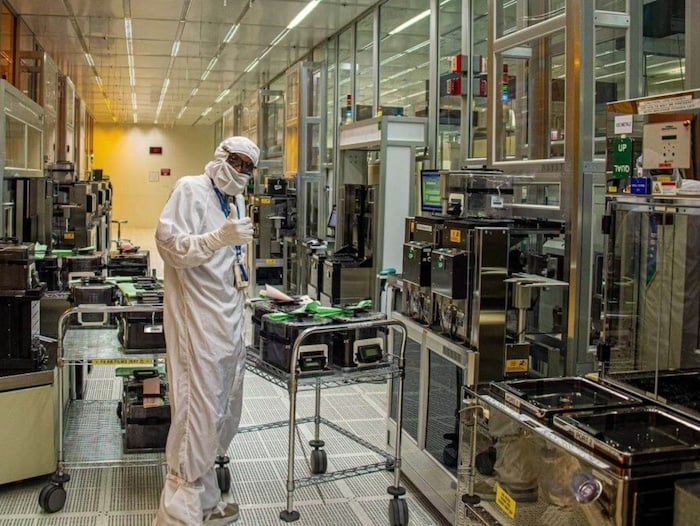
Technician in a Skywater fab. Image used courtesy of Skywater Technology
Skywater’s facilities support specialty processes, heterogeneous integration, and secure manufacturing, all of which align with IonQ’s trapped-ion architectures and long-term plans for fault-tolerant quantum processors. IonQ has tied the acquisition to targets such as functional testing of 200,000-qubit systems by 2028.
Industries affected include government, defense, and research sectors that require trusted, domestic manufacturing for advanced computing hardware. More broadly, the deal highlights how emerging compute paradigms may need vertically integrated manufacturing models when conventional foundry economics do not align with low-volume, high-complexity devices.
Micron Breaks Ground on Advanced NAND Fab in Singapore
Micron has broken ground on a new advanced wafer fabrication facility in Singapore, committing $7B to the initial build and up to $24B, including equipment. The company expects the fab to begin adding NAND wafer output in the second half of 2028.
Singapore has been a cornerstone of Micron’s manufacturing footprint for decades, and the new fab reinforces that role for advanced NAND. While Micron has expanded memory manufacturing in the U.S., the Singapore investment demonstrates that leading-edge memory remains globally distributed.
The fab will produce advanced NAND flash, supporting solid-state storage across data centers, enterprise systems, and consumer devices. As AI workloads drive demand for high-capacity, high-endurance storage, NAND remains a critical complement to DRAM and HBM in the memory hierarchy.
By committing capital years ahead of production, Micron is positioning itself to meet future demand spikes with modern tooling and higher bit density. For Micron’s customers in cloud, automotive, and industrial markets, that translates into a sustained supply of advanced nonvolatile memory as system requirements grow.
Related Content