Facebook
 Google
 GitHub
 Linkedin
Siemens Introduces New Type of Digital Twin Software for SDV Development
Siemens says it can reduce setup time from months to days with the off-the-shelf, cloud-based, digital twin offering.
As vehicles become increasingly software-defined, the challenge for automakers is no longer limited to writing more code. The real difficulty lies in managing system-level complexity as advanced driver-assistance systems (ADAS), autonomous driving (AD), and in-vehicle infotainment (IVI) functions become interconnected.
Siemens is positioning its new PAVE360 Automotive platform as a response to that shift, describing it as a new category of digital twin software built specifically for software-defined vehicle (SDV) development.
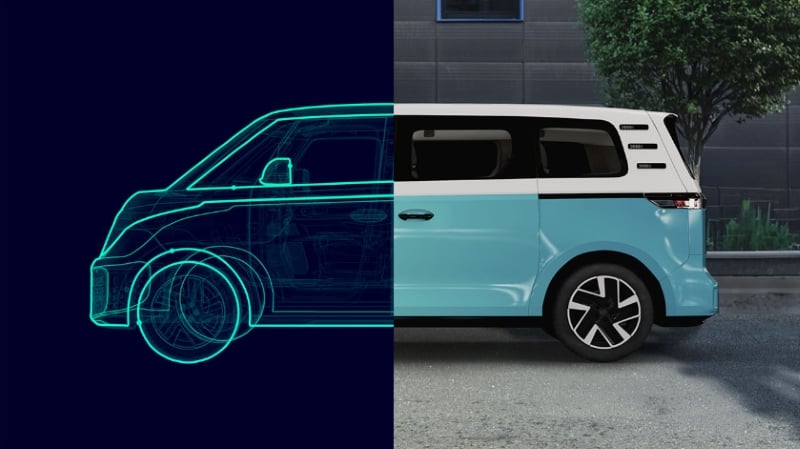
Conceptual view of a software-defined vehicle.
Rather than treating digital twins as project-specific assets that must be assembled from scratch, Siemens frames PAVE360 Automotive as a pre-integrated, off-the-shelf system-level digital twin that enables development teams to begin full-vehicle-level software and hardware co-design from day one.
What Is PAVE360 Automotive?
PAVE360 Automotive is a cloud-based digital twin environment that mirrors real vehicle hardware and software at the system level. It brings together virtual models of ADAS, AD, and IVI electronic control units (ECUs), vehicle networks, and driving scenarios into a single, coordinated development platform.
In traditional automotive development flows, meaningful software integration often cannot begin until physical hardware is available, which creates risk and delays the discovery of system-level issues. PAVE360 Automotive shifts that integration work earlier in the development cycle by providing a ready-made virtual vehicle platform that can be used before silicon or prototype hardware exists.
Siemens describes this approach as a new category of digital twin software because it moves beyond component-level or domain-specific modeling. Instead, it focuses on system-of-systems validation, where interactions between software, hardware, networks, and driving scenarios can be explored together.
The Value of an SDV Digital Twin Blueprint
At the core of PAVE360 Automotive is what Siemens calls an SDV digital twin blueprint. This blueprint provides a reference implementation of both virtual hardware and software, allowing teams to bypass the lengthy process of building a system-level digital twin from scratch.
According to Siemens, assembling and validating a comprehensive automotive digital twin using conventional methods can take years, often undermining the original goal of accelerating development. PAVE360 Automotive can be deployed in days, enabling teams to start experimenting, integrating software, and validating assumptions early.
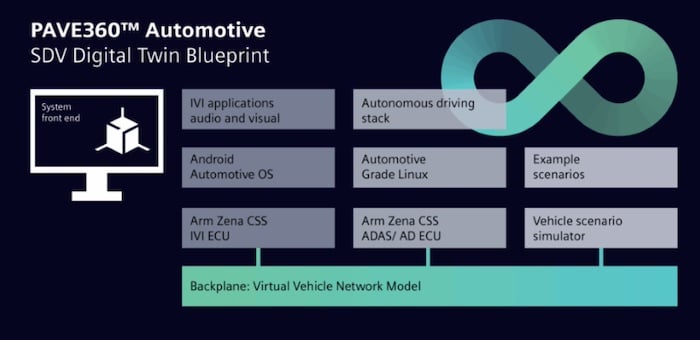
Overview of the PAVE360 Automotive SDV digital twin blueprint.
The blueprint approach also helps surface system interdependencies between ADAS, AD, and IVI functions sooner. As data increasingly flows between these domains, validating them in isolation becomes risky. A shared digital twin allows engineers to test how changes in one domain affect the rest of the vehicle architecture.
Core Features and Benefits for Hardware Designers
For hardware designers, PAVE360 Automotive provides a way to work in parallel with software teams rather than in sequence. The platform supports hardware–software co-design by allowing software development to begin pre-silicon, using virtual platforms that operate at hardware-like simulation speeds. PAVE360 Automotive integrates automotive IP such as Arm Zena Compute Subsystems, enabling engineers to develop and validate software long before first silicon is available. This early access can significantly reduce development timelines while giving hardware teams earlier feedback on architectural decisions.
The platform also supports mixed-fidelity simulation, allowing users to combine fast virtual models with more detailed register-transfer-level (RTL) components when needed. This flexibility helps designers balance speed and accuracy throughout different phases of development.
Enabling Multidisciplinary Collaboration
One of the central goals of PAVE360 Automotive is to break down organizational silos that often exist between hardware, software, and systems teams. The platform provides a single digital twin that multiple teams can work on simultaneously, supporting continuous integration and continuous deployment (CI/CD) workflows at the system level.
Engineers focused on ADAS, IVI, networking, or vehicle dynamics can develop within their own domains while maintaining visibility into system-wide behavior. Validation can extend beyond virtual environments by connecting the digital twin to physical hardware or real vehicles, helping bridge the gap between simulation and real-world performance. Because the platform is based on open standards and APIs, PAVE360 Automotive can also be adapted to existing development flows and extended with third-party tools or in-house models as projects evolve.
Availability and Outlook
PAVE360 Automotive is currently available to selected customers, with general availability planned for February 2026. Siemens is demonstrating the platform publicly this week at CES 2026.
As software-defined vehicles continue to reshape automotive development, Siemens is positioning PAVE360 Automotive as a foundational tool for managing complexity at scale. By providing a pre-integrated, system-level digital twin blueprint, the platform aims to help automakers and suppliers move faster, reduce integration risk, and make more informed design decisions earlier in the development cycle.
All images used courtesy of Siemens.