Facebook
 Google
 GitHub
 Linkedin
Synaptics Launches New Multimodal Gen AI Processors for Smart IoT Edge Designs
Leveraging Synaptics’ partnership with Google Research, the new SoC is positioned between microcontroller-class devices and high-end embedded MPUs.
Yesterday, Synaptics announced its next-generation Astra SL2610, the first product in the Astra SL2600 series of multimodal Gen AI processors. Aimed at edge markets that rely on simultaneously processing vision, audio, voice, and sensor data, the new SoC is said to be a new architectural class within Synaptics’ Astra portfolio, positioned somewhere between microcontroller-class devices and high-end embedded MPUs.
All About Circuits spoke with John Weil, VP & GM for Synaptics’ IoT and Edge AI Processor Business, to learn more about the news firsthand.
A New Approach to Edge MCU Functionality
The SL2610’s MCU subsystem distinguishes it from conventional embedded SoCs. While previous generations treated the MCU as a secondary control block, Synaptics has inverted that hierarchy. Specifically, the system is built around dual Arm Cortex-A55 CPUs operating at 2 GHz, while a Cortex-M52 subsystem with Helium DSP extensions serves as a companion microcontroller for real-time workloads.
This hybrid configuration allows the SoC to transition between ultra-low-power MCU states and high-performance Linux compute environments. Namely, the M52 core can act as the primary execution environment and allow the SoC to boot directly into MCU mode without initializing the A55 cluster or operating system.
As Weil explains, “This allows our power-sensitive customers to actually boot the machine directly into low power mode. Directly in a microcontroller mode, you can shut off the A cores, or never even start them if you want.”
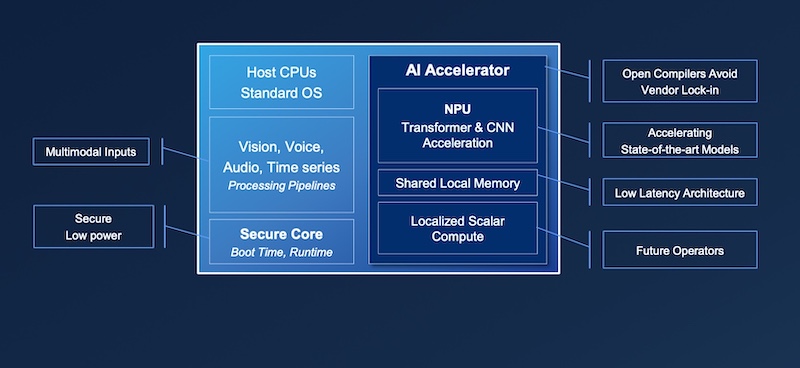
These elements make Synaptics' new “Scalable Silicon Architecture” approach.
For designs such as smart consumer appliances, for example, the MCU’s presence enables the system to operate persistently below one watt while maintaining readiness for AI tasks. When the workload increases (such as invoking a vision or speech model, for example) the SoC can dynamically activate the A-class cores and NPU, execute the AI workload, and then return to MCU mode.
According to Synpatics, the primary benefit is that it provides deterministic real-time control and drastically lowers average power consumption in standby or sensor-monitoring states. Mode-switching capability also allows designers to eliminate separate companion MCUs while still meeting safety and reliability standards through features such as ECC-protected memory paths, IEC 60730 Class B compliance, and PSA Level 3 security certification.
Collaborative NPU Development with Google Research
According to Weil, the SL2610’s architecture was born out of the need for more scalability in an industry where traditional IP licensing models lag behind the AI innovation cycle.
“The normal, traditional way of designing chips can’t keep up with the speed at which AI is being developed,” says Weil. “Therefore, we have to change the game. The big way that Synaptics is changing that game is partnering with the open-source community, and partnering in an open hardware mechanism.”
To this end, one unique element of the SL2610 is its Synaptics Torq Edge AI platform, which merges an in-house NPU with Google Research’s Coral Open NPU technology. Rather than licensing a closed neural IP block, Synaptics and Google co-developed a flexible inference engine based on an open, RISC-V ML accelerator.
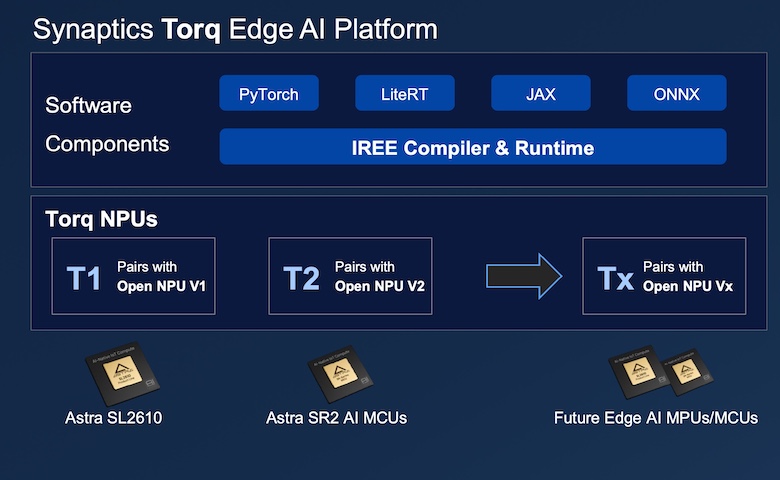
Synaptics and Google partnered for the new Torq edge AI platform.
At the software layer, Torq employs an open-source IREE compiler and MLIR runtime that supports frameworks such as TensorFlow, JAX, and ONNX. It also features Google’s MLIR (Multi-Level Intermediate Representation), which allows the compiler to easily map model graphs dynamically within heterogeneous compute elements. In this way, new AI operators can be added through software without hardware redesigns.
The hardware implementation of Torq includes both Google and Synaptics IP. Google’s Coral NPU is the basis of the inference fabric, while Synaptics contributes system-level integration, memory management, and security extensions that enable the NPU to operate as part of a broader multimodal architecture.
A Practical Approach to Future-Proof Edge AI
With samples shipping now and general availability planned for the second quarter of 2026, Synaptics hopes that the Astra SL2610 will transition the company from embedded processor vendor to provider of AI-native compute platforms. Considering the future, Weil explains the ‘tools first’ approach.
“We have to use modern tools and drive the tool first. We looked at what the software world is already leading with, then built hardware that can leverage that.”
All images used courtesy of Synaptics.