Facebook
 Google
 GitHub
 Linkedin
TDK Merges Sensing and Intelligence at the Edge Like Never Before
All About Circuits met with TDK at CES 2026 to learn how their solutions may redefine sensing, inference, and context awareness in wearables and smart glasses.
At CES 2026, TDK launched a tightly coordinated set of sensing and compute devices that push intelligence deeper into wearables and smart glasses. From custom IMUs with on-chip machine learning to production-ready augmented-reality eyewear, the releases all follow a common throughline: TDK wants sensing, inference, and context awareness to execute locally, not on host processors or in the cloud.
At the show, we spoke to TDK's David Almoslino, Jekwon Yoon, and Aravind Natarajan to learn about the technology and the strategy behind it.
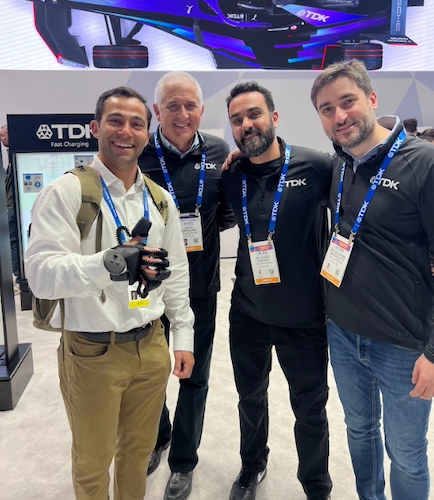
Left to right: All About Circuits contributor Jake Hertz, David Almoslino, Dr. Guido Gioioso, and Dr. Giovanni Spagnoletti.
SmartMotion IMUs Move Fusion and ML onto the Sensor
TDK first announced the new InvenSense SmartMotion IMUs based on the ICM-456xx family. These devices integrate a 6-axis inertial core with on-chip sensor fusion and machine-learning capabilities, enabling the system to execute critical workloads without an external MCU.
With a focus on always-on applications such as smart glasses and earbuds, the IMUs are designed to offload functions, including calibration, gyro-assisted fusion, and activity classification, from the host processor. At the booth, Yoon described why this matters at the system level.
“There are algorithms that used to run all the time,” he said. “If you run any of the algorithms on the MCU, then you have to consume a lot of power, and it’s not really easy for always on.”
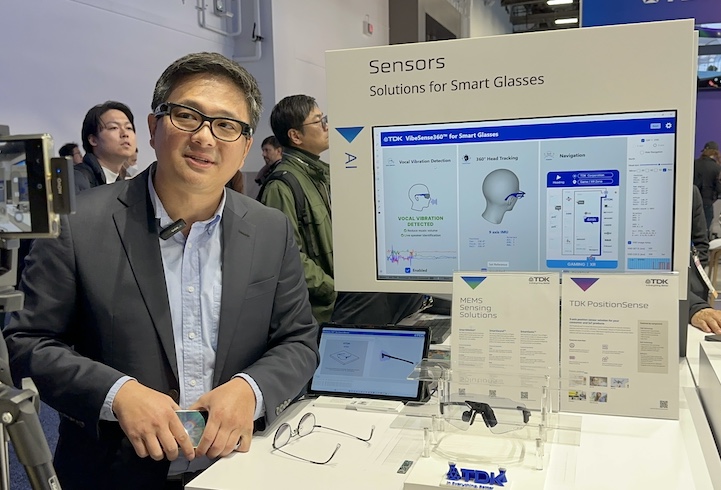
TDK’s Jekwon Yoon demonstrating the company’s IMU technology at CES 2026.
By executing those workloads locally, the IMU allows the rest of the system to remain in a low-power state.
“Sensor fusion runs continuously, and calibration also needs to happen all the time,” Yoon said. “Those are the two main algorithms, and they can now run directly on the IMU.”
From a latency perspective, this also shortens the control loop between physical motion and system response.
To demonstrate this, TDK showcased vocal vibration detection, a feature enabled by the same IMU architecture. Instead of using microphones, the system detects speech by measuring mechanical vibrations captured by the accelerometer. Those vibration signals feed a neural network running locally on the sensor, which can then detect whether the user is talking and adjust other processes (such as audio) accordingly.
Production AR Eyewear and Contextual Sensing Features
TDK’s second CES announcement highlighted its partnership with Engo for production-ready augmented-reality eyewear, powered by its PositionSense motion and magnetic sensor solution. PositionSense combines a 6-axis IMU with a TMR-based magnetometer to deliver absolute orientation with low drift while maintaining ultra-low power operation. TDK claims this announcement is evidence that its sensor-centric architecture scales into shipping hardware.
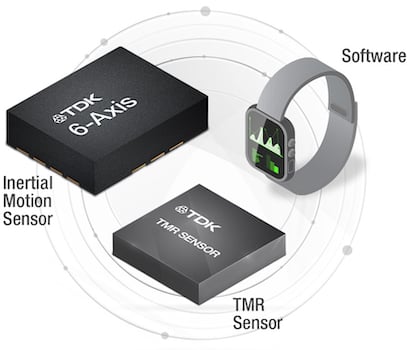
TDK’s PositionSense solution combines an IMU, TMR, and fusion software into a single device. Image used courtesy of TDK
One feature tied directly to this announcement is wear detection, which prevents unnecessary power draw.
“There have been cases where consumers put their glasses in their backpack, and they’re walking around for a long time, and the glasses think that the device should be on.” Almoslino said. “We want to make sure that the glasses are actually waking up only when the person is wearing the glasses.”
TDK’s solution runs wear detection continuously on the sensor. The company paired the SmartMotion announcement with a smart-glasses navigation demo that showed the practical impact of on-sensor fusion. The demo combined an IMU with a digital compass to deliver continuous head-orientation tracking suitable for turn-by-turn guidance.
“Because we have an IMU and a compass, we’re able to track the orientation of the head,” Yoon explained. “And it’s fast enough—faster than what you can perceive.”
The compass provides an absolute heading rather than just relative motion.
“Because we have a compass, we know the true magnetic direction,” he said. “So we can tell you where to go, depending on where you’re headed.”
TDK AIsight and Ultra-Low-Power Vision Processing
TDK’s third CES announcement introduced TDK AIsight, a new group company created to consolidate sensing, vision, and on-device AI into a unified platform for smart glasses. Alongside the organizational launch, TDK disclosed SED0112, an ultra-low-power DSP platform that integrates a microcontroller, a state machine, and a hardware CNN engine optimized for contextual vision and always-on perception.
In contrast to application processors that rely on full-frame image capture and cloud-based inference, the AIsight architecture is meant for selective sensing and localized computation. During the CES demo, TDK engineers showed glasses equipped with both a front-facing camera and a high-resolution contextual camera.
“The idea behind these glasses is that you can take images with a very large field-of-view camera,” said Aravind Natarajan, TDK's head of software development. “But when you’re looking at a certain thing, there’s a very small region of that image we focus on.”
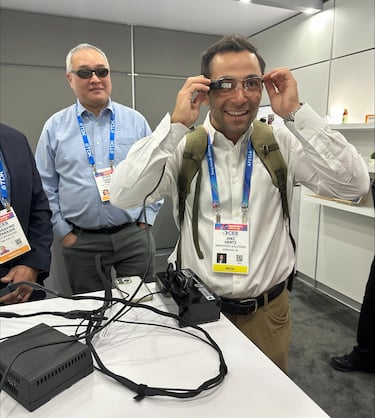
All About Circuits contributor Jake Hertz (left) trying the AIsight glasses demo at CES 2026.
That selective readout strategy is the basis of the platform’s power efficiency.
“By just reading out that small part of the image, you’re able to get rid of the rest,” Natarajan said. “That way the glasses and battery can last longer, while still enabling a lot of use cases.”
Rather than streaming full frames continuously, the system extracts regions of interest and processes them locally on the DSP’s hardware CNN engine. The SED0112 also supports multiple vision sensors at different resolutions, which allows the system to balance contextual awareness with power consumption.
While some higher-level inference still occurred in the cloud during the demo, the AIsight platform aims to minimize data movement.
“You don’t take a picture until you know where you’re looking,” Natarajan explained. “So you only read out the smaller section, and then you transmit that. Every point there is power saved.”
He added that this approach reduces both radio usage and backend processing requirements.
TDK also demonstrated how AIsight integrates with other low-power subsystems to further reduce energy consumption. A secondary low-power sensing path evaluates lighting conditions before activating the high-resolution camera.
“It knows the light scene,” Natarajan said. “So when you enable the high-res camera, you’re not starting from scratch.”
That preconditioning allows the vision pipeline to converge more quickly and avoid unnecessary exposure and processing cycles.
Edge Intelligence Drives the Architecture
Taken together, TDK’s CES announcements bet that smart glasses and wearables will not scale by pushing more data to the cloud or by waking ever-larger processors. Instead, the common thread is intentionally reducing data movement by collapsing sensing, inference, and context awareness into tightly integrated subsystems.
Almoslino succinctly framed that trajectory to finish our interview.
“What we’re showing here on the floor is how these technologies come together,” he said. “The focus is on integrating them into a complete solution for customers and partners.”