Facebook
 Google
 GitHub
 Linkedin
The First Wireless Charging System for the Moon Cleared for Flight
Astrobotic and WiBotic have qualified the first wireless charging system for lunar missions, enabling dust-resistant, connector-free power transfer on the moon.
In a milestone for space infrastructure, Astrobotic and WiBotic have announced the successful flight qualification of the world’s first wireless charging system designed for lunar surface operations.
After a four-month testing campaign that included thermal vacuum exposure, lunar dust trials, vibration, and EMI evaluations, the wireless system has been declared ready for deployment, signaling a shift in how lunar surface assets may soon receive power.
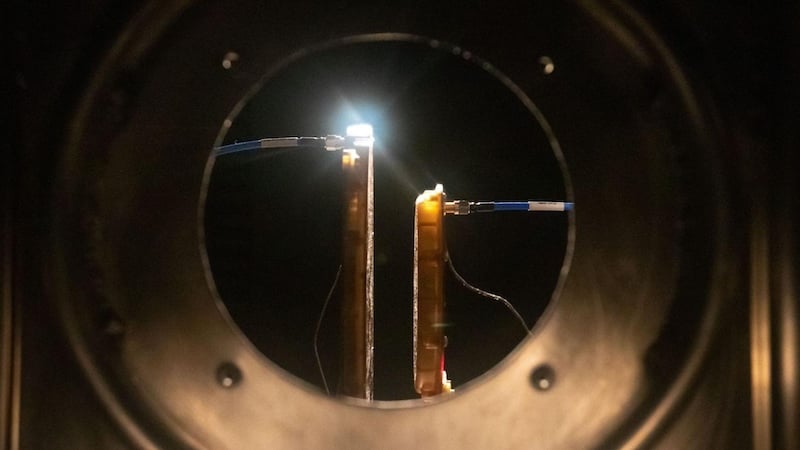
Wireless charging nodes inside the TVAC chamber. Image used courtesy of Astrobotic
As the space industry races to establish long-term lunar presence under programs like NASA’s Artemis, innovations like this wireless charger are laying the groundwork for resilient, interoperable power grids beyond Earth.
Lunar Power Autonomy
The newly qualified system is the product of a NASA-funded collaboration between Astrobotic, WiBotic, Bosch, the University of Washington, and NASA’s Glenn Research Center. Astrobotic served as the project’s prime contractor, integrating the system with its Griffin lander and Vertical Solar Array Technology (VSAT), a 65-foot-tall deployable power platform designed to operate at the lunar south pole.
WiBotic, known for its terrestrial wireless charging solutions in robotics and autonomous systems, contributed its core technology for magnetic resonance-based power transfer. This non-contact method of energy delivery eliminates mechanical connectors, a design choice driven by the moon’s abrasive regolith, which can quickly compromise physical plugs and sockets.
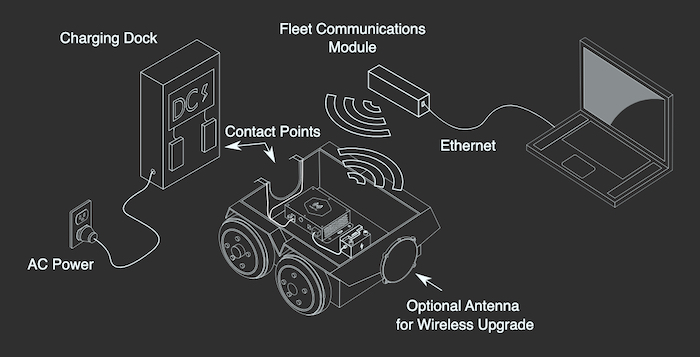
DC power supply and WiBotic's onboard charger in a docking station. Image used courtesy of WiBotic
The wireless system converts electrical energy from solar-powered sources like VSAT into RF fields via a high-efficiency transmitter circuit and antenna coil. Devices equipped with a corresponding receiver coil, such as Astrobotic’s CubeRover, can draw power from these fields simply by approaching the node. Bosch added expertise in autonomous docking and AI-guided positioning to ensure that robots could reliably align with charging nodes, even in the low-gravity, low-light environments of the lunar surface. Meanwhile, researchers at the University of Washington contributed by developing synthetic lunar dust to simulate worst-case contamination scenarios for power transfer, allowing the team to optimize system resilience.
Proven in Simulated Lunar Conditions
This system earned flight qualification through a rigorous testing regime replicating the mechanical and thermal extremes of space. Initial tests were conducted at Astrobotic’s Pittsburgh facility in December 2024, where the charging system operated successfully in a thermal vacuum chamber simulating the moon’s airless, temperature-volatile surface. This was followed by a "dirty TVAC" test at NASA Glenn in January 2025, in which the system was buried in four centimeters of lunar regolith simulant and subjected to temperature swings between -292°F and 220°F. Despite the harsh conditions, the system maintained consistent energy transfer rates, underscoring its robustness against dust interference and thermal shock.
Additional testing at Astrobotic's facilities validated the system's readiness for launch. Vibration testing mimicked the punishing conditions of a rocket's ascent, while EMI testing ensured that the wireless charger would not disrupt other onboard electronics during flight or lunar operation. By passing these hurdles, the system achieved full flight model acceptance, effectively transitioning from concept to a commercially viable component.
Astrobotic’s 125-watt version of the charger is already available for lunar missions, while a more powerful 400-watt variant is undergoing final optimization and has demonstrated transfer efficiencies as high as 85%.
A Standardized Lunar Power Ecosystem
The implications of this development stretch well beyond a single mission. One of the most daunting barriers to lunar exploration has always been power continuity, particularly during the two-week-long lunar night, when solar input disappears and temperatures plummet. This wireless system offers a durable alternative to battery-only operation and provides a practical mechanism for energy distribution across future lunar infrastructure. By enabling safe, dust-tolerant, and connector-free charging, the system reduces maintenance demands and boosts operational uptime in scenarios where manual intervention is limited or impossible.
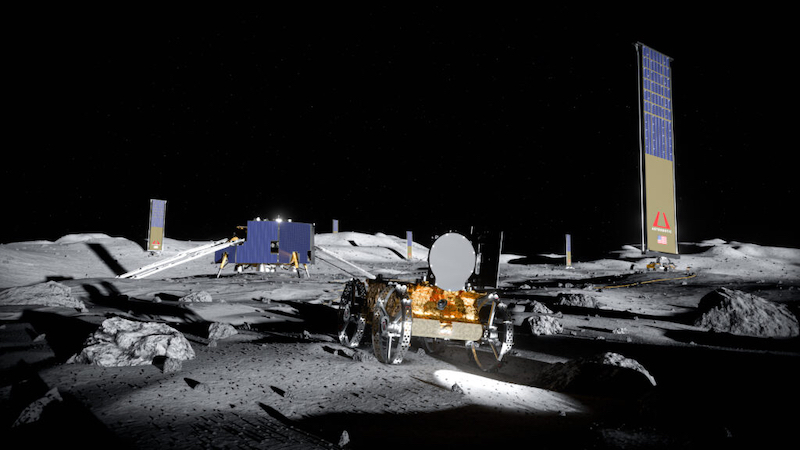
A rendering of LunaGrid, delivered to the moon by Astrobotic’s Griffin lunar lander. The system is composed of several VOLTs and a tethered CubeRover with a wireless charging node. Image used courtesy of Astrobotic
Perhaps most importantly, Astrobotic and WiBotic’s work lays the foundation for a universal lunar power interface. A wireless standard, much like USB or Qi in consumer electronics, could allow equipment from multiple space agencies or commercial vendors to interoperate on a shared energy grid. This vision is already taking shape in Astrobotic’s LunaGrid concept: a modular solar array and charging network deployed via landers and rovers, enabling long-term operations in shadowed craters or hard-to-reach regions of the lunar south pole. As the first flight-ready piece of this vision, the wireless charging system clears a crucial technical hurdle and sets a precedent for future lunar power infrastructure.