Facebook
 Google
 GitHub
 Linkedin
TI to Acquire Silicon Labs, Plus Other News in the Semiconductor World
A cluster of early February deals pulled wireless MCUs, clocking IP, analog sensors, and AI-driven inspection software into larger platforms spanning IoT, automotive, industrial, and semiconductor manufacturing.
Texas Instruments kicked off a busy stretch of semiconductor dealmaking on February 4 with an agreement to acquire Silicon Labs in a $7.5B cash transaction. In the same week, SiTime moved to buy Renesas’s timing business, Infineon agreed to take over a non-optical analog/mixed-signal sensor portfolio from Ams Osram, and Siemens bought Canopus AI to add AI-based computational metrology to its semiconductor manufacturing software.
TI Buys Silicon Labs
TI’s offer values Silicon Labs at $231 per share in cash, with closing expected in the first half of 2027, subject to approvals. TI also attached an unusually concrete integration target for an analog company: $450 million in annual cost synergies within three years of closing, explicitly tied to manufacturing and operations.

Silicon Labs' headquarters in Austin, Texas. Image used courtesy of Lswicker via Wikimedia Commons (CC BY-SA 4.0)
TI says it intends to combine Silicon Labs’ embedded wireless offerings with TI’s in-house manufacturing footprint, and it calls out defined process technologies, including 28 nm, as part of how it expects to scale the combined portfolio. That points to a familiar strategy in TI’s playbook of bringing more devices under process nodes and capacity the company already controls, then using its mature distribution and longevity commitments to win sockets in long-life industrial and commercial programs.
Silicon Labs’ value to TI is the wireless “front end” of a connected system, the portion of the design that tends to dictate things like protocol support, certification pathways, software stacks, and often the upgrade cadence over the product’s lifetime. TI seems to think that pairing those radios and stacks with its existing MCU and analog ecosystem creates a larger, more coherent platform for industrial and automotive connectivity modules, gateways, building automation, and smart commercial systems.
Clocking and Sensors Move Closer to Platform Owners
Timing is a category that rarely headlines product launches, but it’s a dependency everywhere: radios, high-speed serial links, sensor fusion, motor control loops, and, increasingly, the USB- and connectivity-heavy edge devices that sit at the boundary of embedded and application processing. By taking Renesas’ timing unit, SiTime is both adding to its portfolio and trying to pull a major clocking catalog and customer base under one timing specialist’s roadmap.
SiTime’s value proposition has long centered on MEMS-based timing, and one important consideration here is what happens when that approach is paired with the “default” timing parts many designers already specify in mainstream embedded designs. If the acquisition ends with more integrated timing options across MCU and SoC platforms, it changes how much external clocking designers need.
Infineon Bolsters Its Non-Optical Analog and Mixed-Signal Sensors
Infineon is buying a non-optical analog/mixed-signal sensor portfolio for €570M (~$675M), with expected close in Q2 2026. Infineon says the acquired business is expected to deliver about €230M (~$272M) in revenue and to be immediately accretive upon close, with roughly 230 employees transferring.
On the tech side, Infineon is integrating sensor interfaces and mixed-signal sensing devices for automotive and industrial programs, with medical markets also highlighted in the official press release. In theory, this should broaden Infineon’s ability to bundle sensing with its existing power and microcontroller businesses, which is often how suppliers increase share per system in automotive and factory automation designs.
Siemens Buys Metrology Intelligence
Siemens recently acquired Canopus AI to bring AI-based computational metrology to semiconductor manufacturing, specifically targeting wafer and mask inspection data. Founded in 2021, Canopus is a growing software and AI company dedicated to revolutionizing wafer and mask metrology and inspection, according to Siemens.
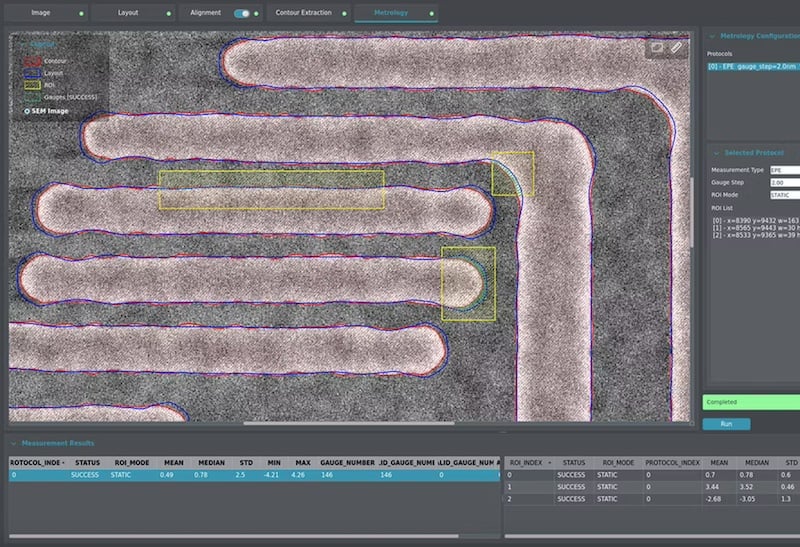
Canopus AI’s ML and AI technology for metrology and inspection. Image used courtesy of Siemens
The transaction highlights how metrology is becoming a software-driven lever for process control, yield learning, and cycle time, rather than merely being a measurement step that produces reports.
As feature sizes shrink and process windows tighten, the amount of data generated by inspection and metrology steps is growing faster than teams' ability to interpret it manually. Siemens is buying specialized capabilities to extract actionable information from that data and integrate it into the broader automation and analytics stack it already sells to fabs.