Facebook
 Google
 GitHub
 Linkedin
Walter Schottky: Bridging Theory and Tech in the Age of Electronics
Ever wonder where the Schottky diode got its name?
Walter H. Schottky combined rigorous theory with practical invention. He made key contributions to vacuum tubes, semiconductor physics, and audio technology. Devices and effects named after him still appear in textbooks and circuit designs. His work helped define how electronics engineers understand and control charge, noise, and rectification.

Historical portrait of Walter Schottky with a Schottky barrier diode. Image (modified) used courtesy of Wikimedia Commons (Public domain) and Mister rf (CC BY-SA 4.0)
Education and Early Career
Schottky was born in Zurich, Switzerland, in 1886, to a father who was a math professor. The family moved to Germany when Schottky was six. He studied physics at the University of Berlin and earned his doctorate in 1912 under Max Planck. His early training focused on thermodynamics and quantum mechanics. These became the basis for his later work on electron emission and space charge.
After a brief postdoc at the University of Jena, Schottky joined Siemens & Halske in 1916. He stayed with the company for decades while also filling academic posts at Würzburg and Rostock in the 1920s. Siemens gave him the freedom to pursue both industrial applications and fundamental physics.
Developing the Schottky Effect
In 1914, Schottky studied how electric fields affect thermionic emission, the flow of electrons from heated metal surfaces. He showed that a strong field lowers the effective work function, allowing more electrons to escape. This became the Schottky effect. It helped improve the design of vacuum tubes by explaining how to increase current without raising temperature.
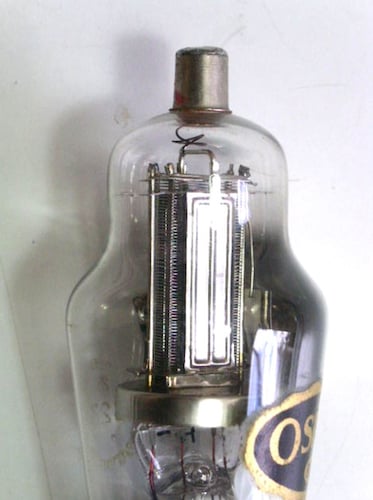
The interior of an Osram S23 screen grid valve. Schottky developed the first tubes having a grid positioned between the anode and the control grid. Image used courtesy of G4oep via Wikimedia Commons (CC BY-SA 4.0)
He invented the screen-grid vacuum tube in 1915. Adding a grid between the control grid and the anode reduced inter-electrode capacitance, which had caused high-frequency instability in triodes. The screen-grid tube made radio receivers more stable and selective. In 1919, he added another grid to create the tetrode. This design suppressed unwanted secondary electron emissions and offered better amplification.
During the same period, Schottky also described what he called Schottky noise (now known as shot noise). He showed that random fluctuations in current result from the discrete nature of charge carriers. His analysis laid the groundwork for understanding noise in amplifiers and detectors.
Audio and Semiconductor Work
In 1924, Schottky and Erwin Gerlach developed the first ribbon microphone. It used a thin aluminum strip suspended in a magnetic field to convert sound waves into electrical signals. The design produced a flat frequency response and a bidirectional pickup pattern, and it became widely used in broadcasting. They also applied the principle in reverse to build the ribbon loudspeaker. Although these concepts were way ahead of their time, later innovations in magnet materials brought them to life in practical applications.
Schottky began working on solid-state theory in the late 1920s. In his 1929 book, he described electron "holes"—the gaps left behind when electrons move. This concept became central to semiconductor theory, and in 1935, he introduced what are now called Schottky defects: paired cation and anion vacancies in ionic crystals. These defects explained how atoms migrate through solids and contributed to the understanding of ionic conduction and material stability.
His most well-known semiconductor contribution came in 1938. He published a theory explaining how a junction between a metal and a semiconductor creates a rectifying barrier. The interface forms a depletion region that blocks current in one direction but allows it in the other. This led to the development of the Schottky diode. Unlike a p-n junction, which relies on diffusion and recombination, a Schottky diode uses majority carrier conduction. It switches faster and has a lower forward voltage drop, typically 0.15 V to 0.45 V compared to 0.6 V to 0.7 V in silicon diodes.
These characteristics make Schottky diodes useful in power electronics, high-speed logic, and RF circuits. Although early metal-semiconductor contacts like cat's-whisker detectors worked on similar principles, Schottky’s theory provided the framework that made precision design possible.
Concepts Named After Schottky
Several effects and laws bear Schottky’s name. These are directly based on his theoretical work and include the:
- Schottky effect, which describes the field-induced lowering of the work function in thermionic emission
- Schottky diode, a metal-semiconductor junction with low forward voltage and fast switching
- Schottky defects, which are paired vacancies in ionic crystals that preserve charge balance
- Schottky anomaly, a specific heat peak at low temperatures caused by discrete energy levels
- The Mott-Schottky equation, which describes how capacitance varies with voltage in semiconductor interfaces
- Langmuir-Schottky law, which describes current in vacuum tubes limited by space charge effects
Schottky received the Hughes Medal from the Royal Society in 1936 for his work on thermionic emission. In 1964, he was awarded the Werner von Siemens Ring for lifetime contributions to technical science. Today, the Walter Schottky Institute in Munich supports semiconductor research, and the Walter Schottky Prize recognizes young physicists in solid-state theory.
He died in 1976 at the age of 89. His work lives on in core electronics concepts, from lab courses to high-speed IC design. If you’ve used a fast rectifier, worked with doping profiles, or designed for thermal noise limits, you’ve already applied Schottky’s work.