Facebook
 Google
 GitHub
 Linkedin
Wearable Tracks Meds for Patients With Bipolar Disorder Through Sweat
A new organic electrochemical transistor-based device offers a needle-free solution for managing bipolar disorder.
Researchers at the University of Southern California recently introduced a wearable lithium sensor that unlocks real-time, non-invasive monitoring of lithium levels in patients with bipolar disorder. The device uses sweat as a medium to measure lithium concentrations and thereby offers a potential alternative to routine blood draws.
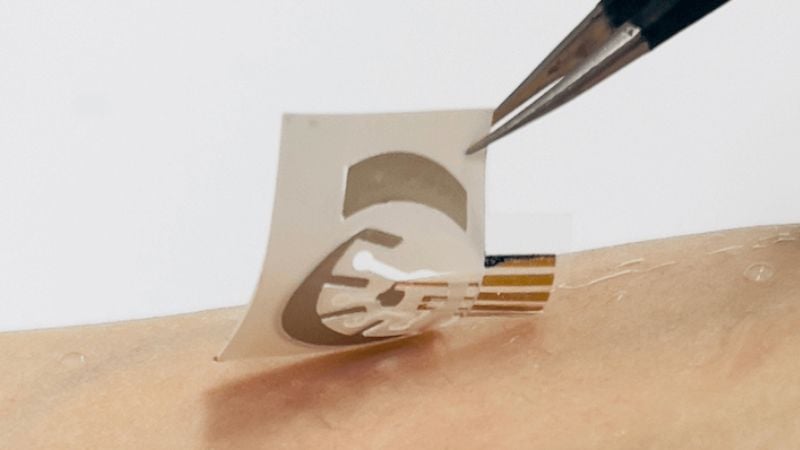
The researchers aimed to make lithium tracking as easy and comfortable for patients as checking a wearable fitness tracker. Image used courtesy of Mohammad Shafiqul Islam, Khan Lab, USC.
The system, which has so far been validated on both healthy individuals and patients undergoing lithium treatment, could have huge implications on treating a prevalent and chronic mental illness in the U.S.
About the WLS-OECT System
The USC research team developed a fully printed organic electrochemical transistor (OECT), fabricated using inkjet and 3D printing techniques. The system is comprised of gold source and drain electrodes, a PEDOT:PSS organic semiconductor channel, and an Ag/AgCl gate electrode. A lithium-selective membrane (ISM) is applied atop the channel to allow ion-specific detection. The ISM itself is made of polyvinyl chloride plasticized with 2-nitrophenyl octyl ether, and incorporates lithium ionophore VI for selectivity.
The researchers mounted the sensor on a flexible plastic substrate and integrated it into a wearable patch, which includes microfluidic channels and iontophoresis electrodes. The iontophoresis system uses pilocarpine-loaded hydrogels to stimulate sweat production on demand. A low current (0.5 mA/cm2) is then applied for 10 minutes to induce localized sweat, which the microfluidic system guides to the sensing area.
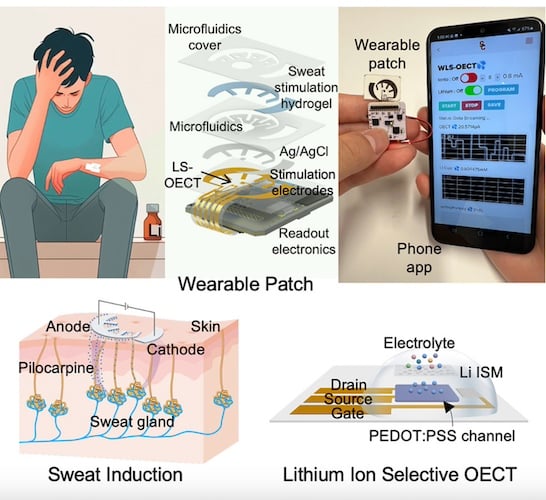
The WLS-OECT system is a wearable solution for detecting lithium concentration via sweat. Image used courtesy of Device
The team measured the transistor’s response by observing a normalized current change that correlates logarithmically with lithium concentration in artificial sweat. In testing, the system demonstrated a sensitivity of 0.5/decade and a detection limit of 0.1 mM to effectively discriminate lithium ions from similar cations such as Na+, K+, Ca2+, and NH4+.
A dedicated readout circuit, powered by an 80-mAh battery, interfaces with the sensor and communicates wirelessly with a smartphone app. The electronics include a DAC, a potentiostat, and a Bluetooth-enabled microcontroller. Users can initiate sweat stimulation and view lithium levels in real time through the app. For consistency, the device uses a one-time calibration curve generated with artificial sweat solutions ranging from 0.1 mM to 10 mM LiCl.
The complete system was tested on six subjects: three healthy individuals and three patients with bipolar disorder undergoing lithium therapy. Lithium concentrations in medicated patients measured approximately 1.5 mM, 1.0 mM, and 0.6 mM, matching dosage regimens of 1,200 mg, 800 mg, and 200 mg per day, respectively. Measurements closely aligned with those obtained using commercial lithium ion-selective electrodes.
The Challenges of Lithium Monitoring in Mental Health Care
Bipolar disorder affects approximately 4.4% of the U.S. population and is primarily treated with lithium. While effective, lithium must be maintained within a narrow therapeutic window, with effective serum concentrations ranging from 0.5 to 1.0 mM. Exceeding 1.5 mM can result in mild to severe toxicity, including tremors or even irreversible neurological damage. Therefore, maintaining therapeutic levels requires frequent monitoring, especially because individual pharmacokinetics vary based on factors like age, weight, metabolism, salt intake, and kidney function.
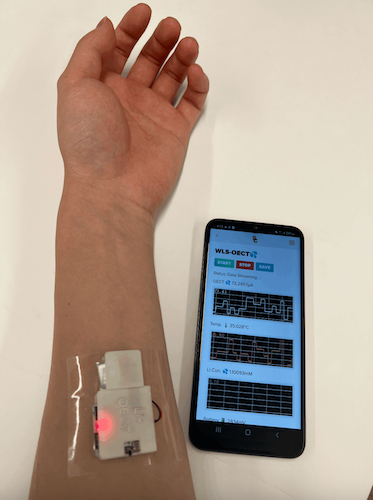
The wearable sensor paired with a smartphone app. Image used courtesy of Mohammad Shafiqul Islam, Khan Lab, USC
Unfortunately, traditional lithium monitoring involves venous blood draws and laboratory analysis, introducing logistical barriers to frequent testing. Such roadblocks deter adherence and increase the risk of unnoticed toxicity or subtherapeutic dosing. Alternative biofluids like saliva and urine have been explored, but have been found unsuitable for continuous measurement due to variability and sample contamination.
Sweat offers a promising alternative. It can be collected non-invasively and stimulated on demand, and previous research has shown a strong correlation between sweat and serum lithium levels.
Healthcare Monitoring Through Non-Invasive Wearables
Researchers at USC believe that the WLS-OECT system could have huge implications for mental health monitoring. With bipolar disorder being so prevalent in the U.S., any solution that facilitates more accurate and convenient treatment is a major boon for those affected by the disorder and their healthcare teams.
Related Content