Facebook
 Google
 GitHub
 Linkedin
Wi-Fi 8 Is on the Horizon. Qualcomm Outlines Priorities and Capabilities
What does a wireless standard look like when shaped by edge cases? Qualcomm has a reliability-focused vision for Wi-Fi 8, slated for 2028.
Wi-Fi typically fails in quiet ways. A skipped packet. A reconnection delay. A latency spike that pushes control traffic outside its useful window. While these glitches don’t always show up in benchmarks, they’re precisely what engineers designing for the edge end up debugging.
That distinction is central to Qualcomm’s proposed priorities for Wi-Fi 8. Qualcomm is one of the leading contributors to the IEEE 802.11bn task group established in late 2023. Since then, the company has submitted several hundred proposals across multiple layers of the stack. As the task group looks forward to Wi-Fi 8, Qualcomm aims to not only boost peak data rates; the updated protocol should bolster real-world reliability, with connectivity that stays usable when a device is in motion, at range, or competing for time in a congested RF field.
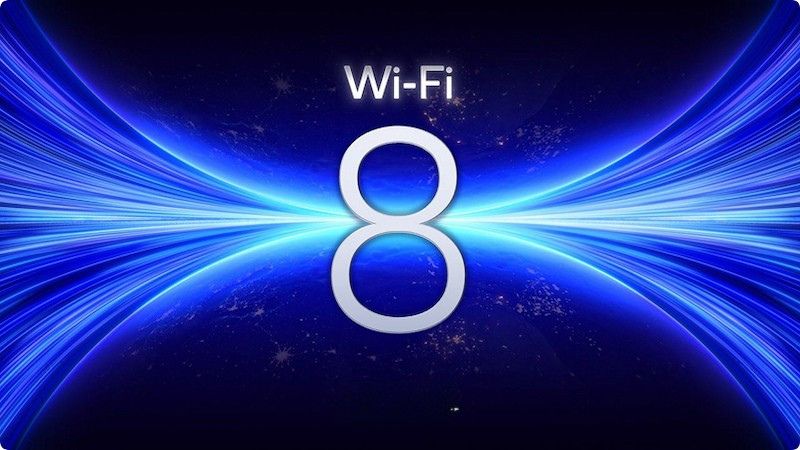
Final IEEE approval for Wi-Fi 8 is expected by mid-2028.
Qualcomm engineers have now proposed a structured shift: design the standard around degraded conditions rather than optimal ones. The approach focuses on three quantifiable targets. First, a 25% improvement in real-world throughput under poor signal quality, interference, or at network edges. Second, a 25% reduction in worst-case latency (not averages, but 95th percentile delays). And third, a 25% reduction in packet loss, especially when devices roam between access points.
Each metric addresses scenarios that conventional Wi-Fi specs largely sidestep. But they’re scenarios that increasingly dominate in enterprise deployments, industrial networks, and real-time systems at the edge.
Coordination Over Isolation
To meet those targets, Qualcomm’s proposal leans heavily on coordinated access point behavior. Instead of treating each AP as an island, the system would treat them as participants in a shared plan that schedules transmissions, shapes coverage, and handles roaming in tandem.
This is far from a new concept. Wi-Fi mesh systems and enterprise controllers already attempt similar functions. What’s different is the push to formalize them at the standard level. Coordinated Spatial Reuse (Co-SR), for example, allows access points to adjust their power levels and reuse channels more efficiently, rather than backing off blindly when congestion rises. Coordinated Beamforming (Co-BF) adds directional control, helping access points shape and align their transmissions to avoid interference and improve coverage.
In lab trials, Qualcomm reports that these coordination techniques can raise throughput by 15–59% depending on deployment density and topology. The result isn’t just seen in terms of higher throughput but also higher predictability. Handoff events become smoother and latency spikes flatten out.
Refining the Physical Layer
Some of Wi-Fi 8’s reliability will come from lower in the stack. Qualcomm has proposed a more granular modulation and coding scheme (MCS) ladder. Earlier standards made relatively large jumps between MCS levels, which meant a sudden drop in performance as link quality dipped. Wi-Fi 8 would smooth those transitions, improving spectral efficiency during coverage fades or while roaming.
There’s also an effort to preserve connectivity at the edges of coverage without relying on fallback modes. Qualcomm refers to this set of techniques as Enhanced Long Range (ELR), involving adjustments to power scaling, timing synchronization, and receive-side sensitivity. These tweaks don’t increase peak performance, but they help devices maintain stable links as they approach physical boundaries where disconnections typically occur.
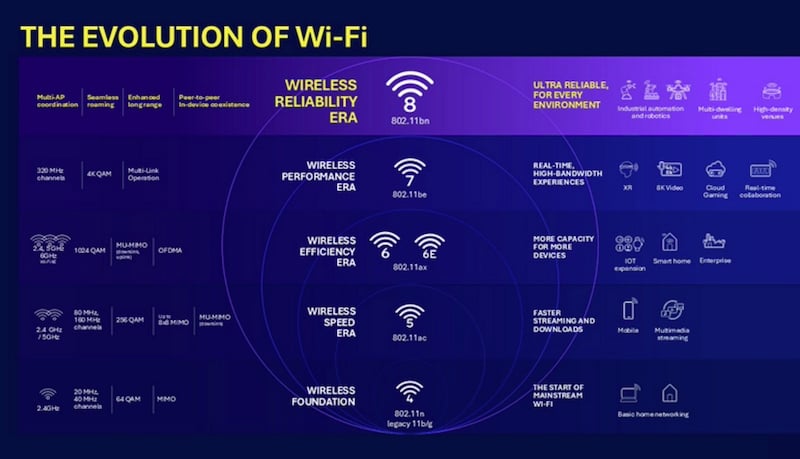
The evolution of Wi-Fi.
Another low-level addition is Non-Primary Channel Access (NPCA), which allows devices to opportunistically use secondary channels when primary ones are occupied. It’s a spectrum-efficiency feature that becomes useful in crowded, heterogeneous deployments such as urban apartments, dense campus floors, or smart factories where hundreds of devices compete for time.
The Standards Process in Motion
Draft 1.0 of the Wi-Fi 8 specification is expected by Q3 2025. The Wi-Fi Alliance certification program is targeting January 2028, with final IEEE approval expected by mid-2028. If the schedule holds, commercial devices supporting the full 802.11bn feature set would ship in late 2028 or 2029.
Unlike the phased rollouts seen in some earlier standards, Wi-Fi 8 is being structured as a single-release specification. That means all baseline features will arrive together, not in waves. Mandatory features will likely include the coordination framework, enhanced modulation schemes, and seamless roaming logic. Optional extensions may cover specialized use cases like industrial automation or millimeter-wave integration.
As of mid-2025, over 6,000 technical contributions have been submitted to the task group. Development work is split into four categories: fast (throughput), reliable (resilience), always-connected (roaming), and beyond (AI integration and future modulation techniques).
Ultimately, what makes this evolution notable is where the effort is being directed. Wi-Fi 8 is a standard being shaped by failure cases. Packet loss during handoff. Latency under congestion. Coverage at the edge. These are the sorts of things that engineers have historically worked around with firmware hacks, controller policies, or expensive deployment strategies.
If the current proposals hold, many of those workarounds could become obsolete. Instead, they’ll be baked into the behavior of the protocol itself.
All images used courtesy of Qualcomm.