
 Facebook
 Google
 GitHub
 Linkedin
William Shockley: The Flawed Visionary Behind Silicon Valley
William Shockley's co-invention of the transistor helped launch the electronics era and Silicon Valley. Though technically brilliant, his poor leadership and endorsement of eugenics in later years tarnished his legacy.
William Bradford Shockley was a pioneering physicist whose innovations helped ignite the electronics revolution. A Nobel Prize laureate and co-inventor of the transistor, Shockley's technical genius was rivaled only by the controversy that consumed his later years.
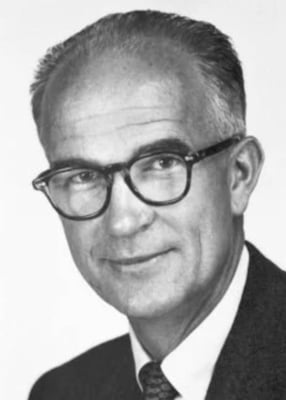
William Shockley. Image used courtesy of Novel Prize Outreach
Shockley's career spanned pioneering advances in solid-state physics and semiconductor technology, and his efforts helped lay the groundwork for what would become Silicon Valley.
Education and Early Research
Born in London in 1910 to American parents, Shockley grew up in Palo Alto, California. His mother homeschooled him in math, and a Stanford physicist next door nurtured his early interest in science. After brief stops at UCLA and the Palo Alto Military Academy, he earned a degree in physics from Caltech, studying under luminaries such as Linus Pauling. He then moved east to MIT, where he completed a Ph.D. in 1936 on electronic band structures, positioning himself squarely within the emerging field of solid-state physics.

Bell Labs' scientists John Bardeen, William Shockley, and Walter Brattain. Image used courtesy of Nokia Bell Labs
Shockley joined Bell Telephone Laboratories immediately after graduation, recruited by Clinton Davisson and research director Mervin Kelly. His early projects involved electron multiplier tubes and copper-oxide semiconductors. He had already begun theorizing about solid-state alternatives to vacuum tubes by the late 1930s, concepts that would eventually evolve into transistor technologies. His 1939 proposal for a field-effect device, though unsuccessful at the time, foreshadowed future breakthroughs.
The Transistor Revolution
World War II paused Shockley’s semiconductor work, and he took leave from Bell Labs to direct Columbia University's Anti-Submarine Warfare Operations Group. There, he applied operations research techniques to submarine detection and bomber radar systems. His strategic analysis of projected U.S. casualties in a land invasion of Japan influenced the decision to deploy atomic bombs.
Returning to Bell Labs in 1945, Shockley was placed in charge of a new solid-state research team that included theorist John Bardeen and experimentalist Walter Brattain. Their goal: create a solid-state amplifier. While Shockley proposed the original concepts, it was Bardeen and Brattain who cracked the problem, leading to the first working point-contact transistor in December 1947. Shockley, frustrated that he wasn't named on their patent applications, began working in secret on his own design.
The result was the junction transistor—a more durable, commercially viable device announced in 1951. This version replaced fragile point contacts with a layered structure that became standard in electronics manufacturing for decades. Shockley's 1950 book, "Electrons and Holes in Semiconductors," laid the theoretical groundwork for the entire field and remains a cornerstone text in electronics engineering.
In 1956, Shockley, Bardeen, and Brattain shared the Nobel Prize in Physics. But personal tensions, especially Shockley’s resentment over credit, had already frayed the group’s collaboration.
Shockley Semiconductor Laboratory
Shockley left Bell Labs in 1955 to found Shockley Semiconductor Laboratory in Mountain View, California, marking the first time anyone had built a company focused solely on silicon electronics. The location was no accident; Shockley returned to be near his aging mother in Palo Alto. More consequentially, this move sowed the seeds of what would soon be known as Silicon Valley.
Yet Shockley’s management proved problematic. Described by colleagues as erratic, paranoid, and domineering, he alienated many of his top recruits. The tipping point came in 1957, when eight of his brightest engineers, whom Shockley later dubbed the "traitorous eight," left to form Fairchild Semiconductor.
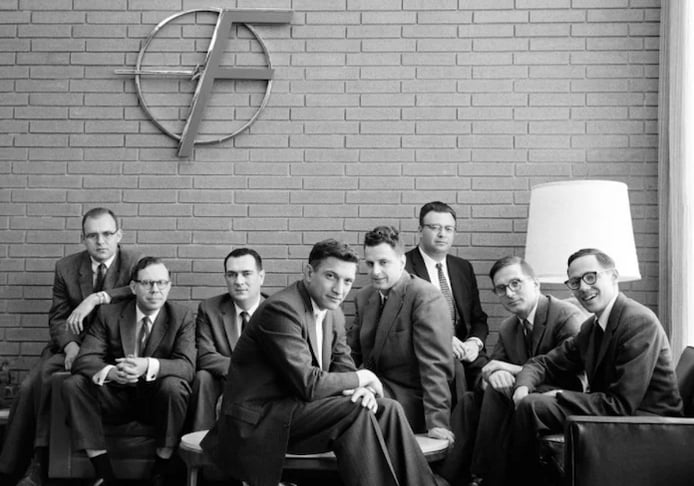
The so-called “traitorous eight.” From left to right: Gordon Moore, Sheldon Roberts, Eugene Kleiner, Robert Noyce, Victor Grinich, Julius Blank, Jean Hoerni, and Jay Last. Image used courtesy of Computer History Museum
From Fairchild, dozens of influential companies (sometimes referred to as "Fairchildren") would later be established, including Intel. Shockley Semiconductor never recovered and shuttered within a decade.
A Complicated Legacy
Afterward, Shockley accepted a professorship at Stanford, but his focus had shifted from semiconductors to heredity. With no formal training in genetics, he began advocating eugenics and promoting scientifically discredited theories about race and intelligence. He proposed that individuals with low IQs be financially incentivized to undergo sterilization, and he made inflammatory claims about racial inferiority. Once a revered inventor, Shockley became a pariah in academic and scientific communities.
Despite this, Shockley’s contributions to modern electronics are undeniable. His invention of the junction transistor and theoretical work laid the groundwork for microelectronics, integrated circuits, and the digital world as we know it. Despite managerial missteps, his ill-fated startup catalyzed the birth of Silicon Valley. If Bardeen and Brattain built the transistor’s hardware, Shockley built the idea, and, inadvertently, the ecosystem that allowed it to flourish.
Shockley died in near-total estrangement from family and former colleagues in 1989.













I was taking math and physics classes at Moorpark College, (Moorpark, CA) in the late 70’s or early 80’s when Mr. Shockley came there one evening to speak. I would soon transfer to Cal Poly, SLO to complete my degree in electrical engineering, so I attended his talk that evening to learn about his involvement in transistor developments. I don’t recall any in-depth talk about physics or electronics, it was primarily centered around his beliefs in racial IQ differences. He presented a slide show of pictures with people of different races to compare their visual image and his view of their intelligence level. It created quite a stir in the audience and angered some. The ‘question/answer’ period following the end of his presentation became racially heated in the audience. After the event, I remember leaving in a somewhat confused state of what I just experienced.