
 Facebook
 Google
 GitHub
 Linkedin
It’s an Analog World
Everything is going digital: cell phones, televisions, video disks, hearing aids, motor controls, audio amplifiers, toys, printers, and what have you. Analog design is obsolete or will be shortly, or so most people think.
Imminent death has been predicted for analog since the advent of the PC. But analog is still here, and analog integrated circuits (ICs) have, in fact, been growing at almost exactly the same rate as digital ones. A digital video disk (DVD) player has more analog content than the VCR—which is analog—ever did.
The explanation is rather simple: the world is fundamentally analog. Hearing is analog. Vision, taste, touch, and smell—all analog. So are lifting and walking. Generators, motors, loudspeakers, microphones, solenoids, batteries, antennas, lamps, LEDs, laser diodes, and sensors are fundamentally analog components.
This book on analog circuit design covers the minority field in the world of semiconductors. A field past glamour, often neglected, but undeniably essential. And a field of great satisfaction for those who know it.
The Digital Revolution is Also Analog
The digital revolution is constructed on top of an analog reality. This fact simply won't go away. Somewhere, somehow, you have to get into and out of the digital system and connect to the real world.
Unfortunately, the predominance and glamor of digital has done harm to analog. Too few analog designers are being educated, creating a void. This leaves decisions affecting analog performance to engineers with a primarily digital background.

Analog and digital signals on an oscilloscope. Image used courtesy of Adobe Stock
In integrated circuits, the relentless pressure toward faster digital speed has resulted in ever-decreasing supply voltages, which are anathema to high-performance analog design.
In a 350 nm process operating at 3.3 V, there’s still enough headroom for a high-performance analog design, though 5 V would be better. At 180 nm (1.8 V), the job becomes elaborate and time-consuming, and performance starts to suffer. At 120 nm (1.2 V), analog design becomes very difficult, even with reduced performance. At 90 nm, analog design is all but impossible.
There are "mixed signal" processes that purportedly allow digital and analog circuitry on the same chip. A 180 nm process, for example, will have some devices that can work with a higher supply voltage (e.g. 3 V). Such additions are welcome, if marginal. However, the design models are often inadequate and oriented toward digital design.
Hence, this book. It should give you an overview of the world of analog IC design so that you can decide what kind of analog function can and cannot, should and should not, be integrated; what should be on the same chip with digital, and what should be separate. Equally important, it will help you identify the right questions to ask the foundry so that your design works the first time.
Fundamental Analog Building Blocks
You’ll find that almost all analog ICs contain a number of recognizable circuit elements. These functional blocks contain just a few transistors, have proven useful, and thus reappear in design after design.
It, therefore, makes sense to first look at such things as current mirrors, compound transistors, differential stages, cascodes, active loads, Darlington connections, or current sources in some detail, and only then examine how they’re best put together to form whole functions.
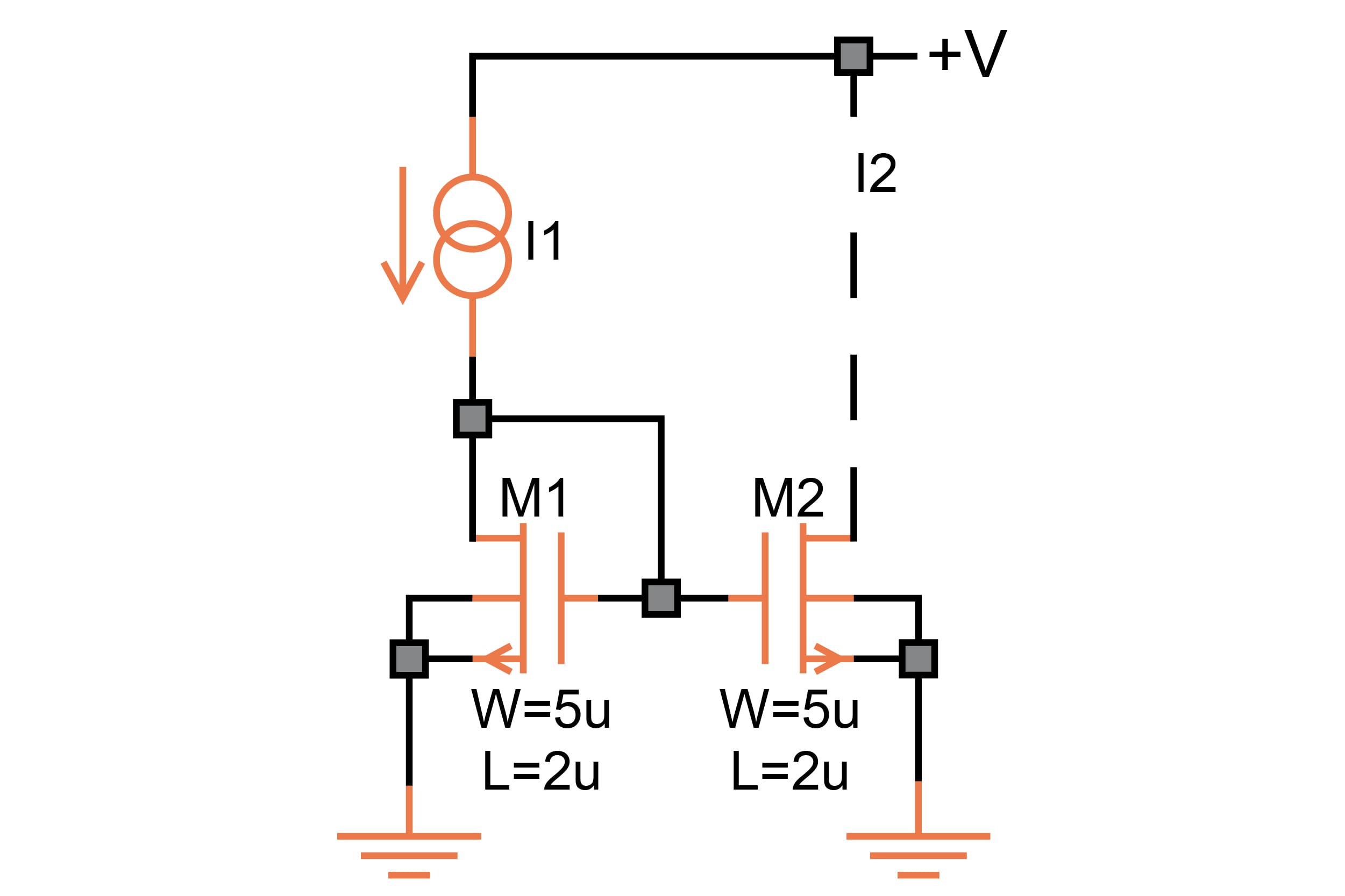
Example of a MOS current mirror.
It's More Than Math
Academic textbooks on IC design are often filled with mathematics. Though it’s important to understand the fundamentals, it’s a waste of time to calculate every detail of a design. Let the simulator do this chore—it can do it better and faster than any human being.
An analysis will tell you within seconds if you’re on the right track and how well your circuit performs. Assuming that you have competent models and a capable simulator, an analysis can teach you more about devices and circuits than words and diagrams on a page.




I am unable to download the PDF version
Echoing Amadeo, I am unable to download the PDF version as well.
All the PDFs books are downloading fine. Please try again.