Facebook
 Google
 GitHub
 Linkedin
AC Electric Circuits
AC Motor Theory
20 questions By Tony R. Kuphaldt
-
Question 4 of 20
A very common design of AC motor is the so-called squirrel cage motor. Describe how a “squirrel cage” motor is built, and classify it as either an “induction” motor or a “synchronous” motor.
Reveal answerThere is a lot of information on “squirrel cage” electric motors. I will leave it to you to do the research.
Notes:Although it is easy enough for students to find information on squirrel cage motors classifying them as either induction or synchronous, you should challenge your students to explain why it is one type or the other. The goal here, as always, is comprehension over memorization.
-
Question 5 of 20
What would we have to do in order to reverse the rotation of this three-phase induction motor?

Explain your answer. Describe how the (simple) solution to this problem works.
Reveal answerReverse any two lines. This will reverse the phase sequence (from ABC to CBA).
Notes:One of the reasons three-phase motors are preferred in industry is the simplicity of rotation reversal. However, this is also a problem because when you connect a three-phase motor to its power source during maintenance or installation procedures, you often do not know which way it will rotate until you turn the power on!
Discuss with your students how an electrician might go about his or her job when installing a three-phase motor. What would be the proper lock-out/tag-out sequence, and steps to take when connecting a motor to its power source? What would have to be done if it is found the motor rotates in the wrong direction?
-
Question 6 of 20
If a copper ring is brought closer to the end of a permanent magnet, a repulsive force will develop between the magnet and the ring. This force will cease, however, when the ring stops moving. What is this effect called?
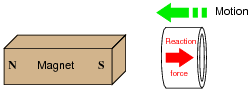
Also, describe what will happen if the copper ring is moved away from the end of the permanent magnet.
Reveal answerThe phenomenon is known as Lenz’ Law. If the copper ring is moved away from the end of the permanent magnet, the direction of force will reverse and become attractive rather than repulsive.
Follow-up question: trace the direction of rotation for the induced electric current in the ring necessary to produce both the repulsive and the attractive force.
Challenge question: what would happen if the magnet’s orientation were reversed (south pole on left and north pole on right)?
Notes:This phenomenon is difficult to demonstrate without a very powerful magnet. However, if you have such apparatus available in your lab area, it would make a great piece for demonstration!
One practical way I’ve demonstrated Lenz’s Law is to obtain a rare-earth magnet (very powerful!), set it pole-up on a table, then drop an aluminum coin (such as a Japanese Yen) so it lands on top of the magnet. If the magnet is strong enough and the coin is light enough, the coin will gently come to rest on the magnet rather than hit hard and bounce off.
A more dramatic illustration of Lenz’s Law is to take the same coin and spin it (on edge) on a table surface. Then, bring the magnet close to the edge of the spinning coin, and watch the coin promptly come to a halt, without contact between the coin and magnet.
Another illustration is to set the aluminum coin on a smooth table surface, then quickly move the magnet over the coin, parallel to the table surface. If the magnet is close enough, the coin will be “dragged” a short distance as the magnet passes over.
In all these demonstrations, it is significant to show to your students that the coin itself is not magnetic. It will not stick to the magnet as an iron or steel coin would, thus any force generated between the coin and magnet is strictly due to induced currents and not ferromagnetism.