Facebook
 Google
 GitHub
 Linkedin
AC Electric Circuits
AC Motor Theory
20 questions By Tony R. Kuphaldt
-
Question 7 of 20
A technique commonly used in special-effects lighting is to sequence the on/off blinking of a string of light bulbs, to produce the effect of motion without any moving objects:
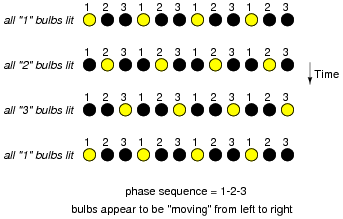
What would the effect be if this string of lights were arranged in a circle instead of a line? Also, explain what would have to change electrically to alter the “speed” of the blinking lights’ “motion”.
Reveal answerIf arranged in a circle, the lights would appear to rotate. The speed of this “rotation” depends on the frequency of the on/off blinking.
Follow-up question: what electrical change(s) would you have to make to reverse the direction of the lights’ apparent motion?
Challenge question: what would happen to the apparent motion of the lights if one of the phases (either 1, 2, or 3) were to fail, so that none of the bulbs with that number would ever light up?
Notes:Ask your students to describe what would happen to the blinking lights if the voltage were increased or decreased. Would this alter the perceived speed of motion?
Although this question may seem insultingly simple to many, its purpose is to introduce other sequenced-based phenomenon such as polyphase electric motor theory, where the answers to analogous questions are not so obvious.
-
Question 8 of 20
If a set of six electromagnet coils were spaced around the periphery of a circle and energized by 3-phase AC power, what would a magnetic compass do that was placed in the center?
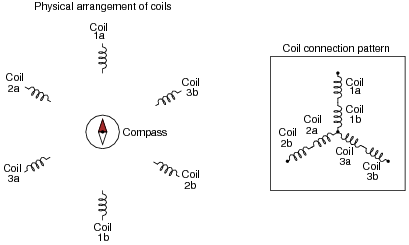
Hint: imagine the electromagnets were light bulbs instead, and the frequency of the AC power was slow enough to see each light bulb cycle in brightness, from fully dark to fully bright and back again. What would the pattern of lights appear to do?
Reveal answerThe compass needle would rotate.
Challenge question: what would happen to the apparent motion of the magnetic field if one of the phases (either 1, 2, or 3) were to fail, so that none of the coils with that number would ever energize?
Notes:The concept of the rotating magnetic field is central to AC motor theory, so it is imperative that students grasp this concept before moving on to more advanced concepts. If you happen to have a string of blinking “Christmas lights” to use as a prop in illustrating a rotating magnetic field, this would be a good thing to show your students during discussion time.
-
Question 9 of 20
Explain what will happen to the magnetized rotor when 3-phase AC power is applied to the stationary electromagnet coils:
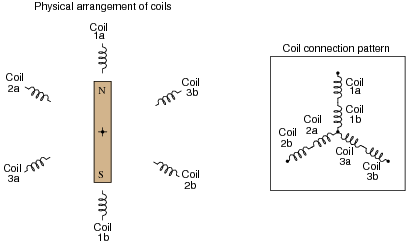
Reveal answerThe magnetic rotor will rotate as it tries to orient itself with the rotating magnetic field.
Follow-up question: what must we do with the AC power energizing the coils to increase the rotor’s rotational speed?
Notes:Here, we see a practical 3-phase electric motor. Be sure to thoroughly discuss what is necessary to increase or decrease rotor speed, and compare this with what is necessary to increase or decrease speed in a DC motor.