Facebook
 Google
 GitHub
 Linkedin
AC Electric Circuits
AC Motor Theory
20 questions By Tony R. Kuphaldt
-
Question 10 of 20
If a closed-circuit wire coil is brought closer to the end of a permanent magnet, a repulsive force will develop between the magnet and the coil. This force will cease, however, when the coil stops moving. What is this effect called?
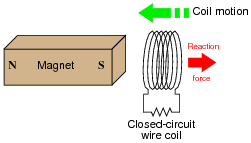
Also, describe what will happen if the wire coil fails open. Does the same effect persist? Why or why not?
Reveal answerThe phenomenon is known as Lenz’ Law, and it exists only when there is a continuous path for current (i.e. a complete circuit) in the wire coil.
Notes:The phenomenon of Lenz’s Law is usually showcased using a metal solid such as a disk or ring, rather than a wire coil, but the phenomenon is the same.
-
Question 11 of 20
Describe what will happen to a closed-circuit wire coil if it is placed in close proximity to an electromagnet energized by alternating current:
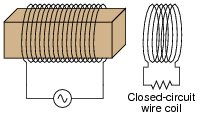
Also, describe what will happen if the wire coil fails open.
Reveal answerThe wire coil will vibrate as it is alternately attracted to, and repelled by, the electromagnet. If the coil fails open, the vibration will cease.
Challenge question: how could we vary the coil’s vibrational force without varying the amplitude of the AC power source?
Notes:Be sure to note in your discussion with students that the coil does not have to be made of a magnetic material, such as iron. Copper or aluminum will work quite nicely because Lenz’s Law is an electromagnetic effect, not a magnetic effect.
The real answer to this question is substantially more complex than the one given. In the example given, I assume that the resistance placed in the coil circuit swamps the coil’s self-inductance. In a case such as this, the coil current will be (approximately) in-phase with the induced voltage. Since the induced voltage will lag 90 degrees behind the incident (electromagnet) field, this means the coil current will also lag 90 degrees behind the incident field, and the force generated between that coil and the AC electromagnet will alternate between attraction and repulsion:
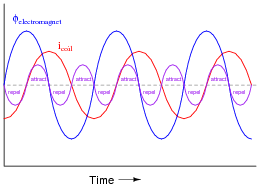
Note the equal-amplitude attraction and repulsion peaks shown on the graph.
However, in situations where the coil’s self-inductance is significant, the coil current will lag behind the induced voltage, causing the coil current waveform to fall further out of phase with the electromagnet current waveform:
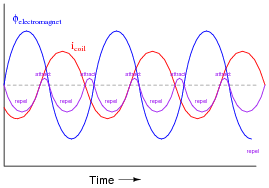
Given a phase shift between the two currents greater than 90 degrees (approaching 180 degrees), there is greater repulsion force for greater duration than there is attractive force. If the coil were a superconducting ring (no resistance whatsoever), the force would only be repulsive!
So, the answer to this “simple” Lenz’s Law question really depends on the coil circuit: whether it is considered primarily resistive or primarily inductive. Only if the coil’s self-inductance is negligible will the reactive force equally alternate between attraction and repulsion. The more inductive (the less resistive) the coil circuit becomes, the more net repulsion there will be.
-
Question 12 of 20
These two electric motor designs are quite similar in appearance, but differ in the specific principle that makes the rotor move:
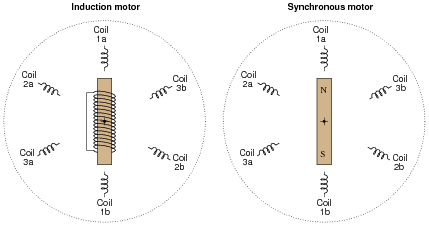
Synchronous AC motors use a permanent magnet rotor, while induction motors use an electromagnet rotor. Explain what practical difference this makes in each motor’s operation, and also explain the meaning of the motors’ names. Why is one called “synchronous” and the other called “induction”?
Reveal answerSynchronous motors rotate in “sync” to the power line frequency. Induction motors rotate a bit slower, their rotors always “slipping” slightly slower than the speed of the rotating magnetic field.
Challenge question: what would happen if an induction motor were mechanically brought up to speed with its rotating magnetic field? Imagine using an engine or some other prime-mover mechanism to force the induction motor’s rotor to rotate at synchronous speed, rather than “slipping” behind synchronous speed as it usually does. What effect(s) would this have?
Notes:It is very important that students realize Lenz’s Law is an induced effect, which only manifests when a changing magnetic field cuts through perpendicular conductors. Ask your students to explain how the word “induction” applies to Lenz’s Law, and to the induction motor design. Ask them what conditions are necessary for electromagnetic induction to occur, and how those conditions are met in the normal operation of an induction motor.
The challenge question is really a test of whether or not students have grasped the concept. If they truly understand how electromagnetic induction takes place in an induction motor, they will realize that there will be no induction when the rotor rotates in “sync” with the rotating magnetic field, and they will be able to relate this loss of induction to rotor torque.