Facebook
 Google
 GitHub
 Linkedin
AC Electric Circuits
AC Motor Theory
20 questions By Tony R. Kuphaldt
-
Question 13 of 20
Synchronous AC motors operate with zero slip, which is what primarily distinguishes them from induction motors. Explain what ßlip” means for an induction motor, and why synchronous motors do not have it.
Reveal answerSynchronous motors do not slip because their rotors are magnetized so as to always follow the rotating magnetic field precisely. Induction motor rotors are become magnetized by induction, necessitating a difference in speed (“slip”) between the rotating magnetic field and the rotor.
Notes:The concept of “slip” is confusing to many students, so be prepared to help them understand by way of multiple explanations, Socratic questioning, and perhaps live demonstrations.
-
Question 14 of 20
An interesting variation on the induction motor theme is the wound-rotor induction motor. In the simplest form of a wound-rotor motor, the rotor’s electromagnet coil terminates on a pair of slip rings which permit contact with stationary carbon brushes, allowing an external circuit to be connected to the rotor coil:

Explain how this motor can be operated as either a synchronous motor or a “plain” induction motor.
Reveal answerA wound-rotor motor with a single rotor coil may be operated as a synchronous motor by energizing the rotor coil with direct current (DC). Induction operation is realized by short-circuiting the slip rings together, through the brush connections.
Challenge question: what will happen to this motor if a resistance is connected between the brushes, instead of a DC source or a short-circuit?
Notes:In reality, almost all large synchronous motors are built this way, with an electromagnetic rotor rather than a permanent-magnet rotor. This allows the motor to start much easier. Ask your students why they think this would be an important feature in a large synchronous motor, to be able to start it as an induction motor. What would happen if AC power were suddenly applied to a large synchronous motor with its rotor already magnetized?
If a resistance is connected between the brushes, it allows for an even easier start-up. By “easier,” I mean a start-up that draws less inrush current, resulting in a gentler ramp up to full speed.
-
Question 15 of 20
Suppose an induction motor were built to run on single-phase AC power rather than polyphase AC power. Instead of multiple sets of windings, it only has one set of windings:

Which way would the rotor start to spin as power is applied?
Reveal answerThe rotor would not spin at all - it would merely vibrate. However, if you mechanically forced the rotor to spin in one direction, it would keep going that direction, speeding up until it reached full speed.
Follow-up question: what does this tell us about the behavior of single-phase induction motors that is fundamentally different from polyphase induction motors?
Challenge question: what does this tell us about the effects of an open line conductor on a three-phase induction motor?
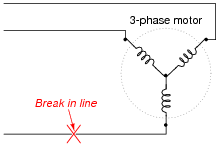
Notes:This is a “trick” question, in that the student is asked to determine which direction the rotor will start to spin, when in fact it has no “preferred” direction of rotation. An excellent means of demonstrating this effect is to take a regular single-phase motor and disconnect its start switch so that it is electrically identical to the motor shown in the question, then connect it to an AC power source. It will not spin until you give the shaft a twist with your hand. But be careful: once it starts to turn, it ramps up to full speed quickly!
The real purpose of this question is to get students to recognize the main “handicap” of a single-phase AC motor, and to understand what is required to overcome that limitation. The challenge question essentially asks students what happens to a three-phase motor that is suddenly forced to operate as a single-phase motor due to a line failure. Incidentally, this is called single-phasing of the motor, and it is not good!