Facebook
 Google
 GitHub
 Linkedin
AC Electric Circuits
AC Motor Theory
20 questions By Tony R. Kuphaldt
-
Question 16 of 20
Describe the operating principles of these three methods for starting single-phase induction motors:
- Shaded pole
- Split-phase, capacitor
- Split-phase (resistor or inductor)
Reveal answerIn each of these techniques, a “trick” is used to create a truly rotating magnetic field from what would normally be a reciprocating (single-phase) magnetic field. The “shaded pole” technique is magnetic, while the other two techniques use phase-shifting. I will leave research of the details up to you.
Notes:There are many details which can be discussed with students regarding these methods of single-phase motor starting. Thankfully, there are many good-quality sources of information on single-phase motor theory and construction, so finding information on this topic will not be difficult for your students.
-
Question 17 of 20
Many single-phase “squirrel-cage” induction motors use a special start winding which is energized only at low (or no) speed. When the rotor reaches full operating speed, the starting switch opens to de-energize the start winding:
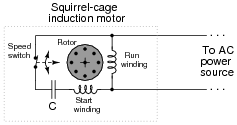
Explain why this special winding is necessary for the motor to start, and also why there is a capacitor connected in series with this start winding. What would happen if the start switch, capacitor, or start winding were to fail open?
Reveal answerSingle-phase AC has no definite direction of “rotation” like polyphase AC does. Consequently, a second, phase-shifted magnetic field must be generated in order to give the rotor a starting torque.
Challenge question: explain what you would have to do to reverse the direction of this “capacitor-start” motor.
Notes:Capacitor-start squirrel-cage induction motors are very popular in applications where there is a need for high starting torque. Many induction motor shop tools (drill presses, lathes, radial-arm saws, air compressors) use capacitor-start motors.
-
Question 18 of 20
The lines of a three-phase power system may be connected to the terminals of a three-phase motor in several different ways. Which of these altered motor connections will result in the motor reversing direction?
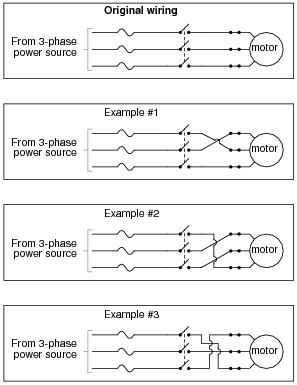
Reveal answerExamples #1 and #3 will reverse the motor’s rotation (as compared to the original wiring). Example #2 will not.
Notes:It is helpful to review the concept of phase rotation sequences as a string of letters: A-B-C, or C-B-A. Although these two letter sequences are the most common for denoting the two different rotation directions, they are not the only sequences possible using three letters. For example, A-C-B, B-A-C, C-A-B, and B-C-A are also possibilities. Discuss with your students which of these letter sequences represents the same direction of rotation as A-B-C, and which represent the same direction of rotation as C-B-A. Then, ask your students how they might apply these letter sequences to the different wiring diagrams shown in the question.