Facebook
 Google
 GitHub
 Linkedin
AC Electric Circuits
AC Motor Theory
20 questions By Tony R. Kuphaldt
-
Question 19 of 20
Some AC induction motors are equipped with multiple windings so they may operate at two distinct speeds (low speed usually being one-half of high speed). Shown here is the connection diagram for one type of two-speed motor:

There are six terminals on the motor itself where the connections are made:
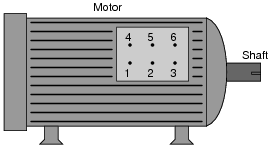
The motor’s datasheet will specify how the connections are to be made. This is typical:
Speed φ-A φ-B φ-C Left open Shorted together
Low 1 2 3 4,5,6
High 4 5 6 1,2,3
Explain why the motor runs at half-speed in one connection scheme and full speed in the other. What is going on that makes this possible?Reveal answerThe difference between the two connection schemes is the polarity of three of the coils in relation to the other three. This is called the consequent pole design of two-speed motor, where you essentially double the number of poles in the motor by reconnection.
Notes:Consequent pole motors are not the only design with multiple speeds. Sometimes motors are wound with completely separate, multiple windings, which give them any combinations of speeds desired.
-
Question 20 of 20
This electric motor was operating just fine, then one day it mysteriously shut down. The electrician discovered two blown fuses, which he then replaced:

When the on/off switch was closed again, the motor made a loud “humming” noise, then became quiet after a few seconds. It never turned, though. Upon inspection, the electrician discovered the same two fuses had blown again.
If you were asked to help troubleshoot this electric motor circuit, what would you recommend as the next step?
Reveal answerObviously, something is wrong with the circuit, if it keeps blowing the same two fuses. So, the answer is not, “install larger fuses!”
It would make sense to proceed by answering this question: what type of fault typically blows fuses? What types of tests could you perform on a circuit like this in order to locate those types of faults? Bear in mind that the behavior of electric motors is quite unlike many other types of loads. This is an electromechanical device, so the problem may not necessarily be limited to electrical faults!
Notes:This question should provoke some interesting discussion! An interesting “twist” to this problem is to suggest (after some discussion) that the motor itself checks out fine when tested with an ohmmeter (no ground faults, no open or shorted windings), and that its shaft may be turned freely by hand. What could possibly be the source of trouble now?