Facebook
 Google
 GitHub
 Linkedin
Analog Integrated Circuits
AC Negative Feedback OpAmp Circuits
14 questions By Tony R. Kuphaldt
-
Question 4 of 14
A common problem encountered in the development of transistor amplifier circuits is unwanted oscillation resulting from parasitic capacitance and inductance forming a positive feedback loop from output to input. Often, these parasitic parameters are quite small (nanohenrys and picofarads), resulting in very high oscillation frequencies.
Another parasitic effect in transistor amplifier circuits is Miller-effect capacitance between the transistor terminals. For common-emitter circuits, the base-collector capacitance (CBC) is especially troublesome because it introduces a feedback path for AC signals to travel directly from the output (collector terminal) to the input (base terminal).
Does this parasitic base-to-collector capacitance encourage or discourage high-frequency oscillations in a common-emitter amplifier circuit? Explain your answer.
Reveal answerThe presence of CBC in a common-emitter circuit mitigates high-frequency oscillations.
Notes:Note that I chose to use a the word “mitigate” instead of give the answer in more plain English. Part of my reasoning here is to veil the given answer from immediate comprehension so that students must think a bit more. Another part of my reasoning is to force students’ vocabularies to expand.
-
Question 5 of 14
A student connects a model CA3130 operational amplifier as a voltage follower (or voltage buffer), which is the simplest type of negative feedback op-amp circuit possible:
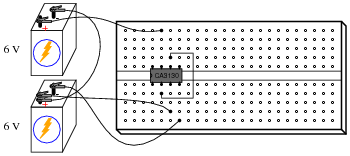
With the non-inverting input connected to ground (the midpoint in the split 6/-6 volt power supply), the student expects to measure 0 volts DC at the output of the op-amp. This is what the DC voltmeter registers, but when set to AC, it registers substantial AC voltage!
Now this is strange. How can a simple voltage buffer output alternating current when its input is grounded and the power supply is pure DC? Perplexed, the student asks the instructor for help. Öh,” the instructor says, “you need a compensation capacitor between pins 1 and 8.” What does the instructor mean by this cryptic suggestion?
Reveal answerSome op-amps are inherently unstable when operated in negative-feedback mode, and will oscillate on their own unless “phase-compensated” by an external capacitor.
Follow-up question: Are there any applications of an op-amp such as the CA3130 where a compensation capacitor is not needed, or worse yet would be an impediment to successful circuit operation? Hint: some models of op-amp (such as the model 741) have built-in compensation capacitors!
Notes:Your students should have researched datasheets for the CA3130 op-amp in search of an answer to this question. Ask them what they found! Which terminals on the CA3130 op-amp do you connect the capacitor between? What size of capacitor is appropriate for this purpose?
Given the fact that some op-amp models come equipped with their own built-in compensation capacitor, what does this tell us about the CA3130’s need for an external capacitor? Why didn’t the manufacturer simply integrate a compensation capacitor into the CA3130’s circuitry as they did with the 741? Or, to phrase the question more directly, ask your students to explain what disadvantage there is in connecting a compensation capacitor to an op-amp.
-
Question 6 of 14
Some operational amplifiers come equipped with compensation capacitors built inside. The classic 741 design is one such opamp:
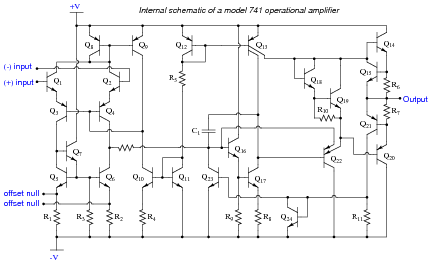
Find the compensation capacitor in this schematic diagram, and identify how it provides frequency-dependent negative feedback within the opamp to reduce gain at high frequencies.
Reveal answerIdentifying the capacitor is easy: it is the only one in the whole circuit! It couples signal from the collector of Q17, which is an active-loaded common-emitter amplifier, to the base of Q16, which is an emitter-follower driving Q17. Since Q17 inverts the signal applied to Q16‘s base, the feedback is degenerative.
Notes:Answering this question will require a review of basic transistor amplifier theory, specifically different configurations of transistor amplifiers and their respective signal phase relationships.
Related Tools:
- Performance-Based Assessments for AC Circuit Competencies
- Parallel DC Circuits Practice Worksheet With Answers