
 Facebook
 Google
 GitHub
 Linkedin
Network Analysis Techniques
AC Network Analysis
24 questions By Tony R. Kuphaldt
-
Question 10 of 24
An AC bridge circuit commonly used to make precision measurements of inductors is the Maxwell-Wien bridge. It uses a combination of standard resistors and capacitors to “balance out” the inductor of unknown value in the opposite arm of the bridge:
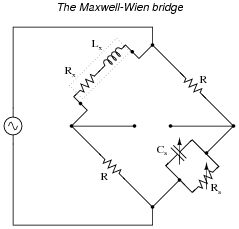
Suppose this bridge circuit balances when Cs is adjusted to 120 nF and Rs is adjusted to 14.25 kΩ. If the source frequency is 400 Hz, and the two fixed-value resistors are 1 kΩ each, calculate the inductance (Lx) and resistance (Rx) of the inductor being tested.
Reveal answerLx = 120 mH
Rx = 70.175 Ω
Notes:There is actually a way to solve for the values of Lx and Rx in a Maxwell-Wien bridge circuit without using complex numbers at all. If one or more of your students find out how to do so through their research, don’t consider it “cheating.” Rather, applaud their research, because they found a quicker path to a solution.
This, of course, doesn’t mean you don’t ask them to work through the problem using complex numbers! The benefit of students researching other means of solution simply provides more alternative solution strategies to the same problem, which is a very good thing.
-
Question 11 of 24
Electrical engineers often represent impedances in rectangular form for the sake of algebraic manipulation: to be able to construct and manipulate equations involving impedance, in terms of the components’ fundamental values (resistors in ohms, capacitors in farads, and inductors in henrys).
For example, the impedance of a series-connected resistor (R) and inductor (L) would be represented as follows, with angular velocity (ω) being equal to 2 πf:
Z = R + j ωL Using the same algebraic notation, represent each of the following complex quantities:
- Impedance of a single capacitor (C) =
- Impedance of a series resistor-capacitor (R, C) network =
- Admittance of a parallel inductor-resistor (L, R) network =
- Admittance of a parallel resistor-capacitor (R, C) network =
Reveal answer- Impedance of a single capacitor \((C) = -j \frac{1}{wC}\)
- Impedance of a series resistor-capacitor (R, C) network \(= R -j \frac{1}{wC}\)
- Admittance of a parallel inductor-resistor (L, R) network \(= \frac{1}{R}-j \frac{1}{wL}\)
- Admittance of a parallel resistor-capacitor (R, C) network \(= \frac{1}{R}+jwC\)
Notes:One possible point of confusion here is the sign of j after inversion. If it is not evident from the answers, 1/j is equal to −j, so that the impedance of an inductor (j ωL) becomes −j [1/(ωL)] when converted into an admittance.
-
Question 12 of 24
Mathematical analysis of the Maxwell-Wien bridge is as follows:
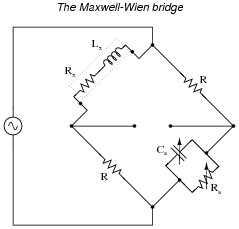
\(Z_x=R_x+jwL_x\) Impedance of unknown inductance/resistance arm \(Z_s= \frac{1}{\frac{1}{R_s}+\frac{1}{-j\frac{1}{wC_s}}}\) Impedance of standard capacitance/resistance arm
\(Y_s= \frac{1}{R_s}+jwC_s\) Admittance of standard capacitance/resistance arm
\(\frac{Z_x}{Z_R}=\frac{Z_R}{Z_s} \ \ \ \ \ \ \ or \ \ \ \ \ \ \ \frac{Z_x}{Z_R}=Z_RY_s\) Bridge balance equation $$Z_x = R^2Y_s$$
$$R_x+jwL_x = R^2 (\frac{1}{R_s}+jwC_s)$$
$$R_x+jwL_x = \frac{R^2}{R_s}+jwR^2C_s$$
Separating real and imaginary terms . . .
\(R_x= \frac{R^2}{R_s}\) (Real) \(jwL_x=jwR^2C_s\) (Imaginary) \(L_x=R^2C_s\) Note that neither of the two equations solving for unknown quantities \((R_x = \frac{R^2}{R_s} \ \ \ and \ \ \ L_x=R^2C_s)\) contain the variable ω. What does this indicate about the Maxwell-Wien bridge?
Reveal answerThis means the source frequency is irrelevant to bridge balance.
Notes:A rule that students will need to be aware of in order to follow all the algebra shown here is 1/j = −j. A brief proof is given here:
$$j^2=-1$$
$$\frac{1}{j^2}= \frac{1}{-1}$$
$$\frac{j}{j^2}= \frac{1}{-1}$$
$$\frac{j}{j^2}= \frac{j}{-1}$$
$$\frac{j}{j^2}= -j$$
$$\frac{1}{j}= -j$$
Otherwise, the admittance equation \((Y_s=\frac{1}{R_s}+jwC_s)\) will not make sense.
One type of AC bridge is called a noise bridge, using a “noise” (broadly mixed frequencies) source as the excitation voltage. Discuss with your students how the Maxwell-Wien bridge would be a suitable topology for use with a noise source, whereas other bridge topologies might not.


