Facebook
 Google
 GitHub
 Linkedin
Network Analysis Techniques
AC Network Analysis
24 questions By Tony R. Kuphaldt
-
Question 19 of 24
Complex quantities may be expressed in either rectangular or polar form. Mathematically, it does not matter which form of expression you use in your calculations.
However, one of these forms relates better to real-world measurements than the other. Which of these mathematical forms (rectangular or polar) relates more naturally to measurements of voltage or current, taken with meters or other electrical instruments? For instance, which form of AC voltage expression, polar or rectangular, best correlates to the total voltage measurement in the following circuit?
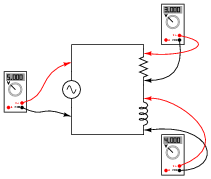
Reveal answerPolar form relates much better to the voltmeter’s display of 5 volts.
Follow-up question: how would you represent the total voltage in this circuit in rectangular form, given the other two voltmeter readings?
Notes:While rectangular notation is mathematically useful, it does not apply directly to measurements taken with real instruments. Some students might suggest that the 3.000 volt reading and the 4.000 volt reading on the other two voltmeters represent the rectangular components (real and imaginary, respectively) of voltage, but this is a special case. In cases where resistance and reactance are mixed (e.g. a practical inductor with winding resistance), the voltage magnitude will be neither the real nor the imaginary component, but rather the polar magnitude.
-
Question 20 of 24
Why are polarity marks ( and -) shown at the terminals of the components in this AC network?
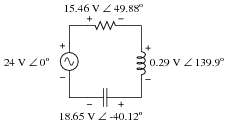
Are these polarity markings really necessary? Do they make any sense at all, given the fact that AC by its very nature has no fixed polarity (because polarity alternates over time)? Explain your answer.
Reveal answerThe polarity markings provide a frame of reference for the phase angles of the voltage drops.
Notes:Ask your students why polarity markings need to be provided in DC electrical networks, as an essential part of the voltage figures. Why is an answer for a voltage drop incomplete if not accompanied by polarity markings in a DC circuit? Discuss this with your students, then ask them to extrapolate this principle to AC circuits. When we are accounting for the phase shift of a voltage drop in our answer, does the “polarity” of the voltage drop matter?
-
Question 21 of 24
You should know that the line voltage of a three-phase, Y-connected, balanced system is always greater than the phase voltage by a factor of √3.
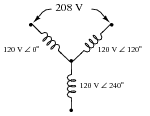
Apply Kirchhoff’s Voltage Law (KVL) to the upper “loop” in this Y-connected alternator schematic to prove how 120 V ∠ 0o and 120 V ∠ 120o makes 208 V. Show the “polarity” marks for each of the voltages as part of your answer.
Reveal answer(120 V ∠ 0o) - (120 V ∠ 120o) = 208 V ∠ -30o
(120 V ∠ 120o) - (120 V ∠ 0o) = 208 V ∠ 150o

Notes:This question is highly effective in demonstrating why polarity markings are important in AC circuit analysis. Without the polarity marks as “frames of reference” for the phase angles, it is impossible to determine the resultant line voltage from the two 120 VAC phase voltages.