Facebook
 Google
 GitHub
 Linkedin
Network Analysis Techniques
AC Network Analysis
24 questions By Tony R. Kuphaldt
-
Question 22 of 24
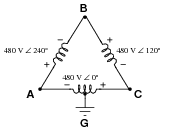
Draw a phasor diagram of the voltages in this Delta-connected polyphase system, and use trigonometry to calculate the voltage between points G and B.
Reveal answer
VBG = 415.7 V
Notes:Of course, complex numbers may also be used to calculate VAB, but the phasor approach has the benefit of graphical intuitiveness.
-
Question 23 of 24
Calculate the load impedance “seen” by the source, through the ideal transformer with a winding turns ratio of 4:1.
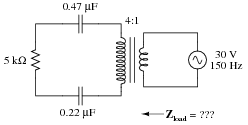
Reveal answerZload = 541.7 Ω ∠ -54.77o
Notes:Ask your students to describe the effect of the transformer’s step-up ratio on impedance magnitude and on impedance phase angle. They may do this by comparing the impedance of the C-R-C circuit on the transformer’s secondary side versus the impedance “seen” at the voltage source terminals. Ask them to explain why one of these parameters is affected but the other is not.
Then, pose the scenario of a real transformer, complete with leakage inductance. Ask your students to explain what effect would leakage inductance have on the load impedance of this circuit.
-
Question 24 of 24
Calculate all voltage drops in this circuit, expressing your answers in complex (polar) form:
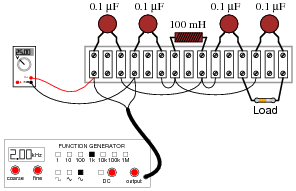
The load resistor’s color code is as follows:
Brown, Black, Black, Brown, Violet
Assume the resistor’s error is 0%. That is, its resistance value is precisely equal to what the “digit” and “multiplier” color bands declare. The signal generator’s output is 25 volts RMS, at a frequency of 2 kHz.
Challenge question: what practical function does this circuit perform?
Reveal answerNotes:The real “answer” to this question is the circuit analysis technique employed. Ask your students, perhaps working teams, to explain how to arrive at the different voltage drop figures. Note any similarities in analysis technique to that of DC circuit analysis.