
 Facebook
 Google
 GitHub
 Linkedin
AC Electric Circuits
AC Power
47 questions By Tony R. Kuphaldt
-
Question 31 of 47
Calculate the line current and power factor in this AC power system:

Now, calculate the line current and power factor for the same circuit after the addition of a capacitor in parallel with the load:
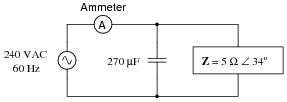
Reveal answer- Without capacitor
- Iline = 48 A
- P.F. = 0.829
- With capacitor
- Iline = 39.87 A
- P.F. = 0.998
Follow-up question: does the addition of the capacitor affect the amount of current through the 5 Ω load? Why or why not?
Notes:The answers to this question may seem really strange to students accustomed to DC circuit calculations, where parallel branch currents always add up to a greater total. With complex numbers, however, the sum is not necessarily greater than the individual values!
-
Question 32 of 47
It is in the best interest of power distribution systems to maintain the power factors of distant loads as close to unity (1) as possible. Explain why.
Reveal answerLow power factors result in excessive line current.
Notes:Ask your students to elaborate on the given answer, explaining why power factor results in excessive line current. Ask them what is meant by the word “excessive.”
-
Question 33 of 47
The “power triangle” is a very useful model for understanding the mathematical relationship between apparent power (S), true power (P), and reactive power (Q):
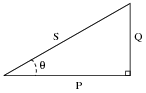
Explain what happens to the triangle if power factor correction components are added to a circuit. What side(s) change length on the triangle, and what happens to the angle Θ?
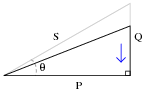
Reveal answerAs power factor is brought closer to unity (1), the power triangle “flattens,” with P remaining constant:
Notes:Ask your students to explain what the “triangle” looks like at a power factor of unity.


