
 Facebook
 Google
 GitHub
 Linkedin
AC Electric Circuits
AC Power
47 questions By Tony R. Kuphaldt
-
Question 7 of 47
If the power waveform is plotted for an AC circuit with a 90 degree phase shift between voltage and current, it will look something like this:
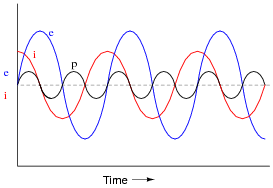
What is the significance of the power value oscillating equally between positive (above the zero line) and negative (below the zero line)? How does this differ from a scenario where there is zero phase shift between voltage and current?
Reveal answerA symmetrically oscillating power waveform represents energy going back and forth between source and load, never actually dissipating.
Notes:Discuss with your students the energy-storing and energy-releasing ability of capacitors and inductors, and how they differ from resistors. This is key to understanding the zero net power dissipation of reactive components in AC circuits.
-
Question 8 of 47
If this circuit is built and operated, it will be found that the resistor becomes much hotter than the inductor, even though both components drop the exact same amount of voltage and carry the exact same amount of current:
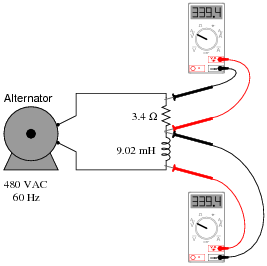
Explain why there is such a remarkable difference in heat output between these two components, given their identical voltage drops and currents.
Reveal answerThe inductor can only store and release energy, not dissipate it. Therefore, its actual power dissipation is zero!
Notes:This question seeks to challenge students’ perceptions of what constitutes electrical power. From the physical effects described, it is evident that there is more to calculating power than simply multiplying a voltage drop by a current!
-
Question 9 of 47
Calculate the current in this circuit, and also the amount of mechanical power (in units of “horsepower”) required to turn this alternator (assume 100% efficiency):

Reveal answerI = 141.18 A
P = 90.8 horsepower
Notes:Solving this problem requires unit conversions: from “watts” to “horsepower.” Let your students research how to perform this conversion, then discuss their various techniques during discussion time.


