Facebook
 Google
 GitHub
 Linkedin
AC Electric Circuits
AC Power
47 questions By Tony R. Kuphaldt
-
Question 4 of 47
Power is easy to calculate in DC circuits. Take for example this DC light bulb circuit:

Calculate the power dissipation in this circuit, and describe the transfer of energy from source to load: where does the energy come from and where does it go to?
Reveal answerP = 264 Watts
If the source is a chemical battery, energy comes from the chemical reactions occurring in the battery’s electrolyte, becomes transfered to electrical form, and then converted to heat and light in the bulb, all at the rate of 264 Joules per second (J/s).
Notes:Discuss with your students the one-way flow of energy in a circuit such as this. Although electric current takes a circular path, the actual transfer of energy is one-way: from source to load. This is very important to understand, as things become more complex when reactive (inductive and capacitive) components are considered.
-
Question 5 of 47
A generator is coupled to a bicycle mechanism, so that a person can generate their own electricity:

The person pedaling this bicycle/generator notices that it becomes more difficult to pedal when the generator is connected to a load such as a light bulb, or when it is charging a battery. When the generator is open-circuited, however, it is very easy to spin. Explain why this is, in terms of work and energy transfer.
Reveal answerThe energy consumed by the load must be supplied by whatever mechanical source turns the generator. In this case, the source is the human being pedaling the bicycle.
Follow-up question: what would it mean if a generator required no physical effort to turn while it was powering an electrical load?
Notes:Discuss how the Law of Energy Conservation relates to this scenario.
-
Question 6 of 47
If the power waveform is plotted for a resistive AC circuit, it will look like this:
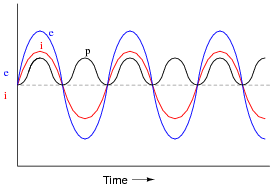
What is the significance of the power value always being positive (above the zero line) and never negative (below the zero line)?
Reveal answerPositive power represents energy flowing from the source to the (resistive) load, in this case meaning that energy never returns from the load back to the source.
Notes:Ask your students what it means in physical terms for energy to flow to a resistive load, and what it would mean for energy to flow from a resistive load back to the source.