
 Facebook
 Google
 GitHub
 Linkedin
AC Electric Circuits
AC Power
47 questions By Tony R. Kuphaldt
-
Question 10 of 47
Calculate the current in this circuit, and also the amount of mechanical power (in units of “horsepower”) required to turn this alternator (assume 100% efficiency):

Reveal answerI = 141.18 A
P = 0 horsepower, so long as the inductor is “pure” (100 percent inductance, with no resistance).
Notes:The answer to this question will surprise many of your students, because they are accustomed to calculating power simply by multiplying voltage by current (P = I E).
Ask your students how they calculated line current in this circuit, and then challenge them with the question of how 0 watts of power can be dissipated in this circuit with all this current and all this voltage (480 volts).
-
Question 11 of 47
A student is pondering the behavior of a simple series RC circuit:
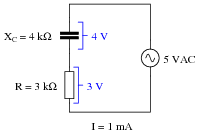
It is clear by now that the 4 kΩ capacitive reactance does not directly add to the 3 kΩ resistance to make 7 kΩ total. Instead, the addition of impedances is vectorial:
√ XC2 + R2= Ztotal ZC + ZR = Ztotal (4kΩ ∠ - 90o) + (3kΩ ∠ 0o) = (5kΩ ∠ - 53.13o) It is also clear to this student that the component voltage drops form a vectorial sum as well, so that 4 volts dropped across the capacitor in series with 3 volts dropped across the resistor really does add up to 5 volts total source voltage:
VC + VR = Vtotal (4V ∠ - 90o) + (3V ∠ 0o) = (5V ∠ - 53.13o) What surprises the student, though, is power. In calculating power for each component, the student arrives at 4 mW for the capacitor (4 volts times 1 milliamp) and 3 mW for the resistor (3 volts times 1 milliamp), but only 5 mW for the total circuit power (5 volts times 1 milliamp). In DC circuits, component power dissipations always added, no matter how strangely their voltages and currents might be related. The student honestly expected the total power to be 7 mW, but that doesn’t make sense with 5 volts total voltage and 1 mA total current.
Then it occurs to the student that power might add vectorially just like impedances and voltage drops. In fact, this seems to be the only way the numbers make any sense:
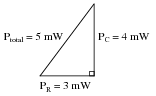
However, after plotting this triangle the student is once again beset with doubt. According to the Law of Energy Conservation, total power in must equal total power out. If the source is inputting 5 mW of power total to this circuit, there should be no possible way that the resistor is dissipating 3 mW and the capacitor is dissipating 4 mW. That would constitute more energy leaving the circuit than what is entering!
What is wrong with this student’s power triangle diagram? How may we make sense of the figures obtained by multiplying voltage by current for each component, and for the total circuit?
Reveal answerOnly the resistor actually dissipates power. The capacitor only absorbs and releases power, so its “4 mW” figure does not actually represent power in the same sense as the resistor. To make this sensible, we must think of all the non-resistive “powers” as something other than actual work being done over time:

Follow-up question: when making the leap from DC circuit analysis to AC circuit analysis, we needed to expand on our understanding of öpposition” from just resistance (R) to include reactance (X) and (ultimately) impedance (Z). Comment on how this expansion of terms and quantities is similar when dealing with “power” in an AC circuit.
Notes:The point of this question is to ease the pain of learning about power factor by relating it to a parallel concept: opposition to electric current (R expanding into X and Z). This makes the follow-up question very significant.
-
Question 12 of 47
Calculate the current in this circuit, and also the amount of mechanical power (in units of “horsepower”) required to turn this alternator (assume 100% efficiency):

Reveal answerI = 99.82 A
P = 45.4 horsepower
Notes:Ask students what each of the load components (inductor and resistor) do with the electrical energy delivered to them by the alternator. The two components behave very differently with regard to power, and only one if them is dissipative.


