
 Facebook
 Google
 GitHub
 Linkedin
AC Electric Circuits
AC Power
47 questions By Tony R. Kuphaldt
-
Question 13 of 47
In this circuit, three common AC loads are modeled as resistances, combined with reactive components in two out of the three cases. Calculate the amount of current registered by each ammeter, and also the amount of power dissipated by each of the loads:
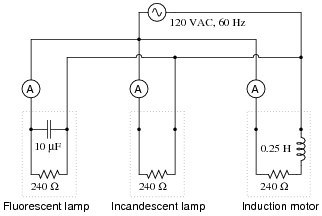
If someone were to read each of the ammeters’ indications and multiply the respective currents by the figure of 120 volts, would the resulting power figures (P = I E) agree with the actual power dissipations? Explain why or why not, for each load.
Reveal answerFluorescent lamp: I = 0.674 A ; Actual power = 60 W
Incandescent lamp: I = 0.5 A ; Actual power = 60 W
Induction motor: I = 0.465 A ; Actual power = 52.0 W
In every load except for the incandescent lamp, more current is drawn from the source than is “necessary” for the amount of power actually dissipated by the load.
Notes:Your students should realize that the only dissipative element in each load is the resistor. Inductors and capacitors, being reactive components, do not actually dissipate power. I have found that students often fail to grasp the concept of device modeling, instead thinking that the resistances shown in the schematic are actual resistors (color bands and all!). Discuss with them if necessary the concept of using standard electrical elements such as resistors, capacitors, and inductors to simulate characteristics of real devices such as lamps and motors. It is not as though one could take an LCR meter and statically measure each of these characteristics! In each case, the resistance represents whatever mechanism is responsible for converting electrical energy into a form that does not return to the circuit, but instead leaves the circuit to do work.
Ask your students how the “excess” current drawn by each load potentially influences the size of wire needed to carry power to that load. Suppose the impedance of each load were 100 times less, resulting in 100 times as much current for each load. Would the “extra” current be significant then?
Being that most heavy AC loads happen to be strongly inductive in nature (large electric motors, electromagnets, and the “leakage” inductance intrinsic to large transformers), what does this mean for AC power systems in general?
-
Question 14 of 47
A very important parameter in AC power circuits is power factor. Explain what “power factor” is, and define its numerical range.
Reveal answerPower factor is the ratio between true power (Watts) and apparent power (Volt-Amps), ranging between 0 and 1 inclusive.
Notes:This is not the only way to define power factor ([P/S]), but it is perhaps the most straightforward.
-
Question 15 of 47
Define true power, in contrast to “reactive” or “apparent” power.
Reveal answerTrue power is that power in a circuit that leaves the circuit and never returns. It is the power that does useful work, plus any dissipative losses.
Notes:Ask your students where they found information helpful to answering this question.


