
 Facebook
 Google
 GitHub
 Linkedin
Discrete Semiconductor Devices and Circuits
Basic AC-DC Power Supplies
31 questions By Tony R. Kuphaldt
-
Question 28 of 31
A simple AC-DC power supply circuit outputs about 6.1 volts DC without a filter capacitor connected, and about 9.3 volts DC with a filter capacitor connected:

Explain why this is. How can the addition of nothing but a capacitor have such a great effect on the amount of DC voltage output by the circuit?
Reveal answerThe filter capacitor captures the peak voltage level of each pulse from the rectifier circuit, holding that peak level during the time between pulses.
Notes:Many new students find this phenomenon paradoxical, especially when they see a DC output voltage greater than the AC (RMS) output voltage of the transformer’s secondary winding. Case in point: being able to build a 30 volt DC power supply using a transformer with a secondary voltage rating of only 24 volts. The purpose of this question is to get students to face this paradox if they have not recognized and resolved it already.
-
Question 29 of 31
A technician is troubleshooting a power supply circuit that outputs substantially less DC voltage than it should. The output voltage is supposed to be 15 volts DC, but instead it is actually outputting less than 8 volts DC:

The technician measures approximately 18 volts AC (RMS) across the secondary winding of the transformer. Based on this voltage measurement and the knowledge that there is reduced DC output voltage, identify two possible faults that could account for the problem and all measured values in this circuit, and also identify two circuit elements that could not possibly be to blame (i.e. two things that you know must be functioning properly, no matter what else may be faulted). The circuit elements you identify as either possibly faulted or properly functioning can be wires, traces, and connections as well as components. Be as specific as you can in your answers, identifying both the circuit element and the type of fault.
- Circuit elements that are possibly faulted
- 1.
- 2.
- Circuit elements that must be functioning properly
- 1.
- 2.
Reveal answerI’ll let you and your classmates figure out some possibilities here!
Notes:Troubleshooting scenarios are always good for stimulating class discussion. Be sure to spend plenty of time in class with your students developing efficient and logical diagnostic procedures, as this will assist them greatly in their careers.
-
Question 30 of 31
A technician is troubleshooting a power supply circuit with no DC output voltage. The output voltage is supposed to be 15 volts DC, but instead it is actually outputting nothing at all (zero volts):
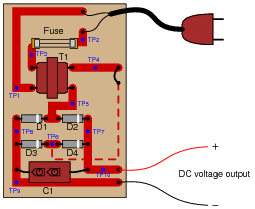
The technician measures 120 volts AC between test points TP1 and TP3. Based on this voltage measurement and the knowledge that there is zero DC output voltage, identify two possible faults that could account for the problem and all measured values in this circuit, and also identify two circuit elements that could not possibly be to blame (i.e. two things that you know must be functioning properly, no matter what else may be faulted). The circuit elements you identify as either possibly faulted or properly functioning can be wires, traces, and connections as well as components. Be as specific as you can in your answers, identifying both the circuit element and the type of fault.
- Circuit elements that are possibly faulted
- 1.
- 2.
- Circuit elements that must be functioning properly
- 1.
- 2.
Reveal answerI’ll let you and your classmates figure out some possibilities here!
Notes:Troubleshooting scenarios are always good for stimulating class discussion. Be sure to spend plenty of time in class with your students developing efficient and logical diagnostic procedures, as this will assist them greatly in their careers.






i m using power supply for CCTV PTZ Camera with his adaptor rating of 230v AC input & 24V AC Output ,2A load current. what would be the power consumption is their from the main supply line? means is it taking 2 amp from main line of it would be from the adaptor itself?