Facebook
 Google
 GitHub
 Linkedin
Network Analysis Techniques
DC Mesh Current Analysis
8 questions By Tony R. Kuphaldt
-
Question 7 of 8
The “Mesh Current” method of network analysis works well to calculate currents in unbalanced bridge circuits. Take this circuit, for example:

Write three mesh equations for this circuit, following these three mesh currents:
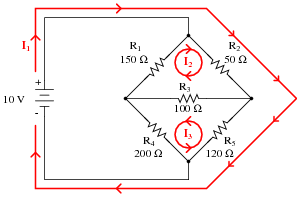
Reveal answerThree mesh equations:
170I1 + 50I2 − 120I3 = 10
50I1 + 300I2 + 100I3 = 0
−120I1 + 100I2 + 420I3 = 0
Notes:Students’ equations may not look exactly like these, depending on how they “stepped” around the loops tallying voltage drops. So long as they are all able to reach the same answers for I1, I2, and I3, it does not matter. In fact, it is a good thing to have different students propose different forms of the equations to demonstrate that the same answers are obtained every time.
Of special importance in this problem is how students represent two meshing currents at a single resistor in their equations. A common mistake for beginning mesh current analysts is to disregard the relative directions of meshing currents. It makes a huge difference whether two mesh currents go the same direction through a resistor, or whether they go in opposite directions!
-
Question 8 of 8
A very interesting style of voltage divider appeared in an issue of Electronics, May 10, 1973. It used three series-connected strings of resistors and connection clips to provide 1000 steps of voltage division with only 31 resistors, of only 3 different resistance values:
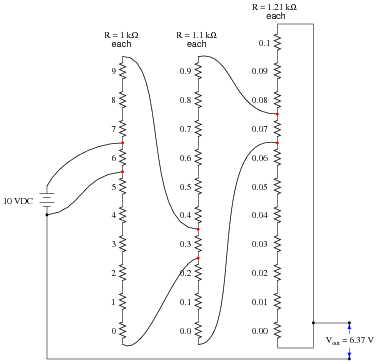
By moving the connection points between these strings of resistors, different fractions of the input voltage may be obtained at the output:
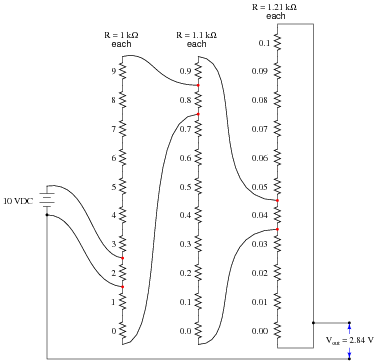
For the purposes of analysis, we may simplify any given configuration of this voltage divider circuit into a network of fewer resistors, in this form:
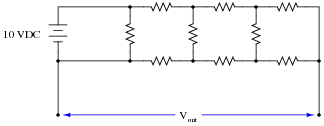
Draw the simplified networks for each of the two given configurations (Vout = 6.37 volts and Vout = 2.84 volts), showing all resistance values, and then apply mesh current analysis to verify the given output voltages in each case.
Note: you will have to solve a set of simultaneous equations: 4 equations with 4 unknowns, in order to obtain each answer. I strongly recommend you use a scientific calculator to perform the necessary arithmetic!
Reveal answerIf you need verification of your work, you should use a computer simulation program such as SPICE to “do the math” for you.
Notes:There is a lot of setup work and arithmetic to do in the analysis of these two circuit configurations. This exercise is not only a thorough application of the mesh current method, but it also serves as an excellent application for computer simulation software. Give your students the opportunity to analyze both these circuits with simulation software, so they may appreciate the power of this technology.
Ask your students this question: “Suppose a student enters their circuit into a computer simulation program, and the program gives them an answer that is known to be incorrect. What does this indicate to the student?” Simulation tools are useful, both only so far as the user understands what he or she is doing. Far too often I encounter students who blindly accept the results of computer simulation, because they mistakenly think that whatever output the computer generates must be correct, not understanding how errors in the input or the use of different simulation algorithms affects accuracy of the simulated results.