Facebook
 Google
 GitHub
 Linkedin
DC Electric Circuits
DC Motor Theory
12 questions By Tony R. Kuphaldt
-
Question 7 of 12
A DC motor may be thought of as a series of electromagnets, radially spaced around a common shaft:
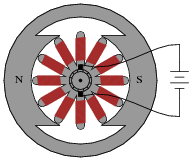
This particular motor is of the “permanent magnet” type, with wire windings only on the armature.
Write the necessary magnetic polarities (“N” for north and “S” for south) on the armature’s electromagnet pole tips, in order to sustain a clockwise rotation.
Reveal answer
Follow-up question: suppose this motor did not rotate like it was supposed to when energized. Identify some possible (specific) failures that could result in the motor not moving upon energization.
Notes:The illustration shown in both the question and the answer provides a good medium for discussing commutation. Discuss with your students how, in order for the motor’s rotation to be continuous, the electromagnets radially spaced around the shaft must energize and de-energize at the right times to always be “pulling” and “pushing” in the correct direction.
Be sure to spend time on the follow-up question with your students, considering non-electrical as well as electrical fault possibilities.
-
Question 8 of 12
Define the following DC motor terms:
- • Field
- • Armature
- • Commutator
- • Brush
Reveal answer- • Field: the portion of the motor creating the stationary magnetic field
- • Armature: the rotating portion of the motor
- • Commutator: copper strips where the armature coil leads terminate, usually located at one end of the shaft
- • Brush: a stationary carbon block designed to electrically contact the moving commutator bars
Notes:Students may find pictures of DC electric motors in their search for these terms’ definitions. Have them show these pictures to the class if possible. Also, a disassembled electric motor is a great “prop” for discussion on electric motor nomenclature.
-
Question 9 of 12
When a DC motor is running, sparks may generally be seen where the carbon brushes contact the “commutator” segments. Explain why this sparking occurs, and also define the word “commutation” in its electrical usage.
What does this phenomenon indicate about the longevity of DC motors, and their suitability in certain environments?
Reveal answerTo “commutate” means “to reverse direction,” in the electrical sense of the word. The result of the commutator bars and brushes alternately making and breaking the electrical circuit with the armature windings invariably causes some degree of sparking to occur.
Follow-up question: identify an environment where a sparking motor would be unsafe.
Notes:If your students find themselves working in some sort of electrical maintenance jobs, what types of routine maintenance do they think they might have to do on DC electric motors, given the presence of sparking at the commutator? Ask them what safety issues this sparking could present in certain environments. Ask them if they think there are any environments that would be especially detrimental to a motor design such as this.