Facebook
 Google
 GitHub
 Linkedin
DC Electric Circuits
DC Motor Theory
12 questions By Tony R. Kuphaldt
-
Question 4 of 12
If an electric current is passed through this wire, which direction will the wire be pushed (by the interaction of the magnetic fields)?
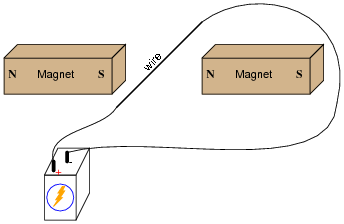
Is this an example of an electric motor or an electric generator?
Reveal answerThe wire will be pushed up in this motor example.
Notes:A visual aid to understanding the interaction of the two magnetic fields is a diagram showing the lines of flux emanating from the permanent magnets, against the circular lines of flux around the wire. Ask those students who came across similar illustrations in their research to draw a picture of this on the board in front of the class, for those who have not seen it.
-
Question 5 of 12
If we were to analyze the magnetic flux lines of a current-carrying conductor, oriented perpendicularly to a magnetic field between two bar magnets, the interaction would look something like this:
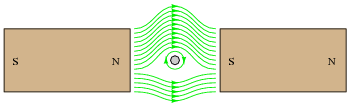
This interaction of magnetic flux lines (the bar magnets’ straight lines versus the wire’s circles) will produce a mechanical force on the wire (called the Lorentz force). Which direction will this force act? Also, determine the direction of current through the conductor (seen from an end-view in the above illustration) necessary to produce the circular magnetic flux shown.
Reveal answer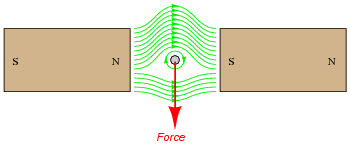
Notes:This question serves as a good application of the right-hand rule (or left-hand rule, if you follow electron flow notation).
-
Question 6 of 12
If current is passed through a loop of wire, as shown, which direction will the loop rotate?
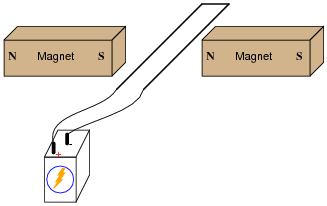
Reveal answerClockwise, one-quarter turn (90 degrees).
Notes:Ask your students to identify the poles of the electromagnetic field produced by this current-carrying wire loop, and then its direction of torque may become easier to understand.