Facebook
 Google
 GitHub
 Linkedin
AC Electric Circuits
Design Project: Sensitive Audio Detector
5 questions By Tony R. Kuphaldt
-
Question 4 of 5
With the headphones connected to the input of your audio detector circuit, what is the lowest current level of signal you can hear, as measured with a sensitive milliammeter connected in series between your detector and a signal source?
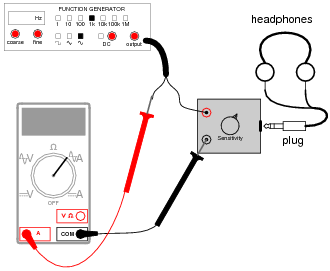
Compare this against the lowest amount of audible signal current for the headphones directly. Which component of the detector circuit is responsible for this increased sensitivity?
Reveal answerThe transformer. But, can you explain why?
Notes:This is a very practical way for students to experience the significance of impedance matching using transformers.
-
Question 5 of 5
Suppose I wish to listen to the “hum” of ripple voltage from an AC-to-DC power supply using this detector. “Ripple voltage,” in case you don’t know, is a small AC voltage superimposed on a large DC voltage. If I simply connect my detector directly to the power supply’s terminals, I hear a LOUD “click.” If I turn the volume control down until the “click” is tolerable, the hum is too faint to hear. If I turn the volume control up far enough to hear the hum, then the “click” is far too loud for comfort.
How can I set up the detector so that it only detects the AC portion (the “ripple” voltage) of the power supply’s output, and not the DC portion?
Reveal answerThis is actually quite simple to do, and it involves connecting a specific type of component in series with the detector’s test leads. I won’t directly tell you what this component is, but I’ll give you a hint: you will be doing that same thing that is done inside an oscilloscope when you set the “coupling” switch from the “DC” position to the “AC” position.
Follow-up question: modify the schematic diagram to include an AC/DC coupling switch, so the detector’s coupling may be switched from one mode to the other just like an oscilloscope.
Notes:It would be very helpful to have an AC-DC power supply with substantial ripple voltage available for students to do this exercise.