
 Facebook
 Google
 GitHub
 Linkedin
Digital Circuits
Digital Display Circuits
15 questions By Tony R. Kuphaldt
-
Question 13 of 15
An obsolete display technology that still finds enthusiastic followers in the hobbyist world, called Nixie tubes, relies on a BCD-to-10 decoder to drive one of ten different metal cathodes inside a neon-filled glass bulb. For each BCD code, exactly one of the cathode figures inside the “Nixie tube” will glow, causing that numeral to shine with a pink-orange light. The tube receives power through a common anode (usually over 150 volts DC).
A friend of yours is trying to build his own Nixie tube display circuit, but is experiencing problems. He wants to use a 7442 BCD-to-10 decoder to drive ten discrete transistors, each one handling the current for a digit in the tube. Being cautious, your friend decides to connect just one of the Nixie tube digits to a transistor, and then to the 7442, to see if the idea works (before connecting all ten).

Unfortunately, that one digit begins to glow the moment the high-voltage DC supply is turned on, even before the 7442 chip receives power! And after that, the 7442 gets warm to the touch, which is not good.
Thinking he has damaged the 7442 IC, your friend turns to you for advice. Did he do anything wrong here? Explain what advice you would give to him.
Reveal answerThe transistor is not correct. Your friend will have to have a different transistor output stage for his display circuit!
Follow-up question: comment on your friends’ strategy to connect only one transistor to one Nixie tube cathode for a test. Was this a good idea? Why or why not? Did doing this save the 7442 from further damage?
Notes:I have left the answer purposefully vague so that students will have to figure out how to properly use BJTs to drive the Nixie tube cathodes. This is a good opportunity for them to review BJT theory and switch application use, so don’t spoil it by giving away the answer!
-
Question 14 of 15
Liquid crystal display (LCD) technology used to have very narrow viewing angles. Anyone who remembers the first LCD displays on portable personal computers will recall how you could only see the display if you viewed it perpendicular to the display surface, or at a very slight angle from perpendicular.
Modern LCD technology is much better, is still not as good as viewing printed paper, the “gold standard” for non-emissive display. One term frequently used to describe the quality of viewing with regard to angle is Lambertian. Define what “Lambertian” means with regard to display surfaces.
Reveal answerA “Lambertian” surface emits (or reflects) light with an intensity proportional to the cosine of the viewing angle (relative to perpendicular). Paper is Lambertian in its reflective characteristics, which is one of the reasons it is so easy to read compared to contemporary digital display technologies.
Notes:This question is destined for obsolescence, as Lambertian displays will likely become a reality in the next several years. But for now (May 2005), it is a term worth defining in the introductory study of display technologies.
An example of an early attempt at full-Lambertian display is the Gyricon technology developed by Xerox. Research this and be prepared to discuss it with your students as an example of a novel approach for non-emissive electronic displays.
-
Question 15 of 15
One method of driving pixels in a grid-based display is to organize the pixels into rows and columns, then select individual pixels for illumination by the intersection of a specific row line and a specific column line. In this example, we are controlling an 8 × 8 grid of LEDs with two 8-bit (1-byte) ports of a microcontroller:
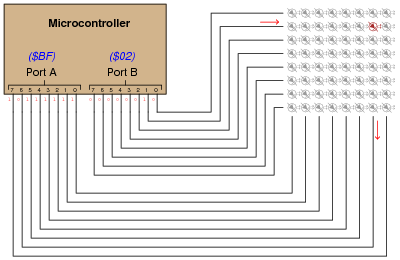
Note that a high state is required on one of port B’s pins to activate a row, and a low state is required on one of port A’s pins to activate a column, because the LED anodes connect to port A and the LED cathodes connect to port B.
Determine the hexadecimal codes we would need to output at ports A and B to energize the LED in the far lower-left corner of the 8 × 8 grid.
Port A =
Port B =
Reveal answerPort A = $FE
Port B = $80


