Facebook
 Google
 GitHub
 Linkedin
Basic Electricity
Lock-out / Tag-out
8 questions By Tony R. Kuphaldt
-
Question 4 of 8
When using a padlock to secure a disconnect device in the “open” (off) state, who should be able to open that lock? In other words, how many other people should share a key to the lock you use to secure a breaker or switch in the safe position, if you are the one working on the system?
Reveal answerYou and you alone should be able to open that lock. It needs to be a personal lock, not a lock whose key is shared by other people.
Notes:Discuss with your students why a personal lock is preferred over a “group” lock for locking out circuit disconnect devices.
-
Question 5 of 8
When securing equipment for safe maintenance, special tags are attached with the lock(s) used to keep circuit breakers and other disconnect devices in the open (off) state. A typical “lockout” tag looks something like this:
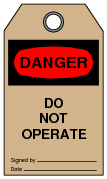
What is the purpose of attaching such a tag to an electrical disconnect device in addition to locking it in the open position? Why is a lock, by itself, not sufficient from a safety perspective?
Reveal answerA tag informs anyone wishing to turn the disconnect device “on” as to when it was turned off, and who placed the lock(s) on it. Many lockout tags have space on for a written description so that the reason for the lockout may be explained.
Notes:Discuss with your students the need for good communication between all people performing maintenance work on large and (potentially) dangerous systems. Tags are an integral part of this communication.
-
Question 6 of 8
What step(s) must be taken after locking and tagging an electrical disconnect device for a circuit to be worked on, and prior to actually proceeding with the work? What step(s) come between the lock-out and the work itself?
Reveal answerCheck for the presence of voltage on the conductors of the circuit to be worked on.
Notes:There is more to this answer than simply “check for voltage.” Ask your students to explain what types of voltage they need to check for, and how they can ensure their voltmeters are properly functioning, so as not to “miss” detecting a dangerous condition.