Facebook
 Google
 GitHub
 Linkedin
Basic Electricity
Magnetism
10 questions By Tony R. Kuphaldt
-
Question 1 of 10
A permanent magnet is a device that retains a magnetic field without need for a power source. Though many of us have experienced the effects of magnetism from a permanent magnet, very few people can describe what causes permanent magnetism. Explain the cause of permanent magnetism, in your own words.
Reveal answerMagnetism is caused by electric charges in motion. Since electrons in atoms are known to move in certain ways, they are able to produce their own magnetic fields. In some types of materials, the motions of atomic electrons are easily aligned with respect to one another, causing an overall magnetic field to be produced by the material.
Follow-up question: what does the term retentivity mean, in relation to permanent magnetism?
Notes:The answers students find to this question may be philosophically unsatisfying. It is one thing to discover that magnetism is produced by moving electric charges, but quite another to discover (much less explain) just what a magnetic field is in an ontological sense. Sure, it is easy to explain what magnetic fields do, or even how they relate to other phenomenon. But what, exactly, is a magnetic field? This question is on the same level as, “what is an electric charge?”
-
Question 2 of 10
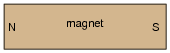
If we were to trace the magnetic lines of flux extending from this bar magnet, what would they appear like?
Reveal answer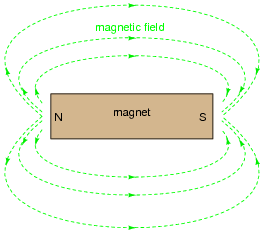
Challenge question: design an experiment to reveal the patterns of magnetic flux lines in visual form.
Notes:Experiments designed to reveal the patterns of magnetic flux lines are easy to set up. Try to have some iron filings, and some powerful bar magnets, available in your class for this purpose!
-
Question 3 of 10
Magnetic poles are designated by two labels: “North” and “South”. How are these labels defined? Explain how we can experimentally determine which ends of a magnet are “North” and “South”, respectively?
Reveal answerThe end of a magnet that points to the north pole of the Earth is called the “North” pole of the magnet.
Notes:After your students explain how to experimentally determine the poles of a magnet, challenge them with this question: given that like poles repel and opposite poles attract, what are the proper magnetic pole designations for the Earth’s actual poles? If the “north” end of a bar magnet orients itself so that it is geographically pointing north, what “magnetic polarity” does the actual North pole of the Earth have?