Facebook
 Google
 GitHub
 Linkedin
Basic Electricity
Magnetism
10 questions By Tony R. Kuphaldt
-
Question 4 of 10
Devise a method of identifying the poles of a magnet that is too large and heavy to move.
Reveal answerI’ll give you a hint: you could use another magnet!
Notes:This is another question designed to provoke students to think creatively in problem-solving. They should already understand the principle of suspending a magnet and using the Earth’s natural magnetic field to identify the magnet’s poles. However, this requires allowing the magnet to freely rotate (hence the requirement of suspension) so it can act as a compass. Using the same process to identify the poles of an immovable magnet may require the use of an intermediary magnet, combined with the knowledge of magnet pole interactions (repulsion versus attraction).
-
Question 5 of 10
What happens to the magnetic lines of flux emanating from a magnet, when an unmagnetized piece of iron is placed near it?
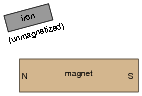
Reveal answer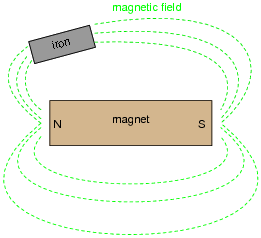
Challenge question: can you think of any practical applications of this field-distortion effect?
Notes:A previously unmagnetized piece of iron will become magnetized once exposed to the magnetic field of a nearby magnet. This fact leads to another question, namely, what magnetic pole assignments does the iron piece assume in this condition? Ask your students to identify which end of the iron becomes “North” and which end of the iron becomes “South”.
One application of magnetic field distortion is the remote detection of vehicles and other objects made of ferrous metals. There is an historical wartime application of this principle, which may prove interesting for discussion purposes!
-
Question 6 of 10
Describe the so-called “domain theory” of magnetism, as it applies to permanent magnets.
Reveal answerI’ll let you research the answer to this question!
Notes:First, ask your students what a “permanent” magnet is. Are there other kinds of magnets? If so, what might they be called?
One of the more interesting applications of domain theory is bubble memory, a type of computer memory technology making use of localized “bubbles” of magnetism in a material corresponding to discrete magnetic domains. You might want to bring this up in discussion, if none of your students do it first.