
 Facebook
 Google
 GitHub
 Linkedin
Basic Electricity
Basic Circuit Troubleshooting
18 questions By Tony R. Kuphaldt
-
Question 1 of 18
Determine if the light bulb will de-energize for each of the following breaks in the circuit. Consider just one break at a time:
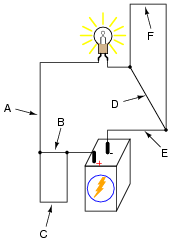
- • Choose one option for each point:
- • A: de-energize / no effect
- • B: de-energize / no effect
- • C: de-energize / no effect
- • D: de-energize / no effect
- • E: de-energize / no effect
- • F: de-energize / no effect
Reveal answer- • A: de-energize
- • B: no effect
- • C: no effect
- • D: no effect
- • E: de-energize
- • F: no effect
Notes:This question is an important one in the students’ process of learning troubleshooting. Emphasize the importance of inductive thinking: deriving general principles from specific instances. What does the behavior of this circuit tell us about electrical continuity?
-
Question 2 of 18
Examine the following illustration of a simple battery-switch-lamp circuit, connected together using screw-terminal blocks, each connection point on each terminal block identified by a unique number:
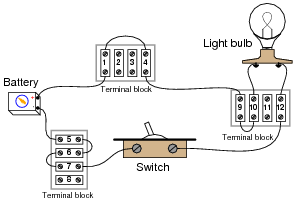
Determine whether or not voltage should be present between the following pairs of terminal block points with the switch in the ON position:
- • Points 1 and 5:
- • Points 6 and 7:
- • Points 4 and 10:
- • Points 9 and 12:
- • Points 6 and 12:
- • Points 9 and 10:
- • Points 4 and 7:
Now, determine whether or not voltage should be present between the following pairs of terminal block points with the switch in the OFF position:
- • Points 1 and 5:
- • Points 6 and 7:
- • Points 4 and 10:
- • Points 9 and 12:
- • Points 6 and 12:
- • Points 9 and 10:
- • Points 4 and 7:
Reveal answerSwitch ON:
- • Points 1 and 5: Voltage!
- • Points 6 and 7: No voltage
- • Points 4 and 10: No voltage
- • Points 9 and 12: Voltage!
- • Points 6 and 12: No voltage
- • Points 9 and 10: No voltage
- • Points 4 and 7: Voltage!
Switch OFF:
- • Points 1 and 5: Voltage!
- • Points 6 and 7: No voltage
- • Points 4 and 10: No voltage
- • Points 9 and 12: No voltage
- • Points 6 and 12: Voltage!
- • Points 9 and 10: No voltage
- • Points 4 and 7: Voltage!
Follow-up question: explain why there will be voltage or no voltage between each of these pairs of points for the two circuit conditions (switch on and switch off).
Notes:This question is not really a troubleshooting question per se, but the principles involved in successfully determining the presence or absence of voltage are critically important to being able to troubleshoot simple circuits using a voltmeter.
I have found that the concept of electrically common points is most helpful when students first learn to relate voltage drop with continuity (breaks or non-breaks) in a circuit. You might want them to identify which points in this circuit are electrically common to one another (in either or both switch positions).
-
Question 3 of 18
The following battery-switch-lamp circuit has a problem. Over time, corrosion has developed between the wire end and the screw terminal labeled “4” on the upper side of the top terminal block. This corroded connection now has a high resistance instead of a low resistance as it should. As a result, the light bulb does not energize when the switch is turned ON:
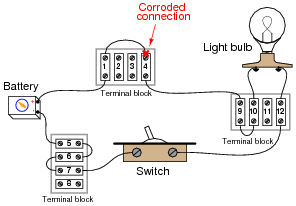
Taking voltage measurements with a voltmeter, how do you think this corrosion problem will reveal itself with the switch on the ON position? In other words, which voltage measurement in this circuit (i.e. between which pair or pairs of terminal block points) will be unusual as a result of the bad connection at point #4, and approximately how much voltage should that measurement be?
Reveal answerWith the corroded connection at terminal #4, the following voltage measurements should read abnormally high (almost full battery voltage, whereas they should register zero volts if all connections in the circuit are good):
- • Points 1 and 4
- • Points 1 and 10
• Points 1 and 10 Follow-up question: there are also several voltage measurements in this faulty circuit that will read abnormally low as a result of the corroded connection at point #4. Identify which pairs of points the abnormally low voltage will be measured between.Notes:Explain to your students what environmental factors contribute to corrosion (water, acids, caustics, etc.) and how a corroded electrical connection is usually not equivalent to a complete “open” break in a circuit. Quite often a corroded connection is a substantial resistance of unstable value, leading to intermittent problems in the circuit.





May I know the people who created these examples? through APA 6 or 7 format of citation?
Some good brain teasers. It was nice getting my head wrapped around the idea of getting voltage on a common side of a circuit (due to a break on that side) 🤠