Facebook
 Google
 GitHub
 Linkedin
Analog Integrated Circuits
Negative Feedback OpAmp Circuits
21 questions By Tony R. Kuphaldt
-
Question 10 of 21
This operational amplifier circuit is often referred to as a voltage buffer, because it has unity gain (0 dB) and therefore simply reproduces, or “buffers,” the input voltage:
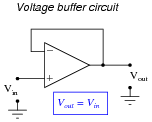
What possible use is a circuit such as this, which offers no voltage gain or any other form of signal modification? Wouldn’t a straight piece of wire do the same thing? Explain your answers.
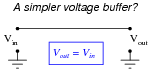
Reveal answerWhile this circuit offers no voltage gain, it does offer current gain and impedance transformation. Much like the common-collector (or common-drain) single transistor amplifier circuits which also had voltage gains of (near) unity, opamp buffer circuits are useful whenever one must drive a relatively “heavy” (low impedance) load with a signal coming from a “weak” (high impedance) source.
Notes:I have found that some students have difficulty with the terms “heavy” and “light” in reference to load characteristics. That a “heavy” load would have very few ohms of impedance, and a “light” load would have many ohms of impedance seems counter-intuitive to some. It all makes sense, though, once students realize the terms “heavy” and “light” refer to the amount of current drawn by the respective loads.
Ask your students to explain why the straight piece of wire fails to “buffer” the voltage signal in the same way the the opamp follower circuit does.
-
Question 11 of 21
For all practical purposes, how much voltage exists between the inverting and non-inverting input terminals of an op-amp in a functioning negative-feedback circuit?
Reveal answerZero volts
Notes:Ask your students to explain why there will be (practically) no voltage between the input terminals of an operational amplifier when it is used in a negative feedback circuit.
-
Question 12 of 21
Just as certain assumptions are often made for bipolar transistors in order to simplify their analysis in circuits (an ideal BJT has negligible base current, IC = IE, constant β, etc.), we often make assumptions about operational amplifiers so we may more easily analyze their behavior in closed-loop circuits. Identify some of these ideal opamp assumptions as they relate to the following parameters:
- Magnitude of input terminal currents:
- Input impedance:
- Output impedance:
- Input voltage range:
- Output voltage range:
- Differential voltage (between input terminals) with negative feedback:
Reveal answer- Magnitude of input terminal currents: infinitesimal
- Input impedance: infinite
- Output impedance: infinitesimal
- Input voltage range: never exceeding V/-V
- Output voltage range: never exceeding V/-V
- Differential voltage (between input terminals) with negative feedback: infinitesimal
Notes:Just in case your students are unfamiliar with the words infinite and infinitesimal, tell them they simply mean “bigger than big” and “smaller than small”, respectively.