
 Facebook
 Google
 GitHub
 Linkedin
Basic Electricity
Ohm’s Law Practice Worksheet With Answers
23 questions By Tony R. Kuphaldt
-
Question 10 of 23
One style of light bulb, very different from the “incandescent” design which works on the principle of a super-heated wire filament emitting light, is called a gas discharge tube. In this design of light bulb, light is produced by the direct “excitation” of gas molecules as electric current passes between two electrodes:

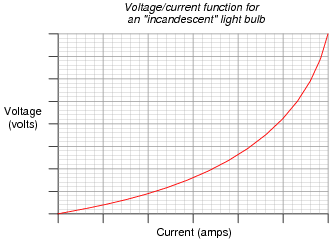
Both types of light bulbs have interesting voltage/current plots, neither one being identical to the voltage/current plot of a resistor. First, the voltage/current plot for an incandescent light bulb:
Next, the voltage/current plot for a gas-discharge light bulb:
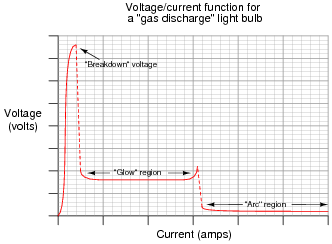
Based on these two graphs, what can you say about the electrical resistance of each bulb type over its operating range?
Reveal answerUnlike a resistor, which offers a relatively fixed (unchanging) amount of resistance to the motion of electrons over a wide range of operating conditions, the electrical resistance of light bulbs typically change dramatically over their respective operating ranges.
From the graphs, determine where the resistance for each type of light bulb is at its maximum, and where the resistance is at its minimum.
Notes:Many types of electrical and electronic components experience changes in electrical resistance over their operating ranges of current and voltage. Resistors, while simple to study, do not exhibit the behavior of most electronic components. It is important for students to understand that the real world of electricity and electronics is much more complex than what Ohm’s Law might suggest (with an implicit assumption of fixed resistance). This is one concept that graphs really help to illustrate.
-
Question 11 of 23
Draw the schematic diagram for an experimental circuit to gather data necessary to plot the voltage/current graph of a gas discharge lamp.
Reveal answer
Notes:One of my goals as a technical educator is to encourage the development of experimentation skills in my students. The most accurate way to gain knowledge of a device’s operation or of an electrical principle is to build a circuit that actually tests it. I’ve used this technique many times in my career to further my knowledge on a subject, and it has proven to be an invaluable skill.
In this question, students are implicitly asked to identify several key things:
- • Where to connect a meter to measure lamp voltage.
- • Where to connect a meter to measure lamp current.
- • How to make the current adjustable, so that multiple values may be tested and plotted.
Additionally, the students must identify what voltage/current ranges will be necessary to test a gas-discharge lamp. Notice the high-voltage power source shown in the schematic diagram. Students may ask “How high must this voltage be?” upon seeing the schematic in the answer. Don’t tell them outright. Rather, have them do some research and report the next day on typical lamp voltages!
-
Question 12 of 23
What is negative resistance?
Reveal answer“Negative resistance” is where an electrical component passes less current as the voltage dropped across it increases.
Notes:Not only do many gas-discharge devices exhibit negative resistance over certain portions of their operating range, but many semiconductor devices do as well.



The questions are very interesting.