
 Facebook
 Google
 GitHub
 Linkedin
Basic Electricity
Ohm’s Law Practice Worksheet With Answers
23 questions By Tony R. Kuphaldt
-
Question 7 of 23
∫f(x) dx Calculus alert!
Plot the relationships between voltage and current for resistors of three different values (1 Ω, 2 Ω, and 3 Ω), all on the same graph: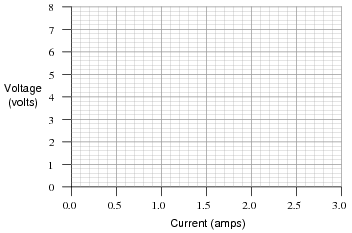
What pattern do you see represented by your three plots? What relationship is there between the amount of resistance and the nature of the voltage/current function as it appears on the graph?
Advanced question: in calculus, the instantaneous rate-of-change of an (x,y) function is expressed through the use of the derivative notation: [dy/dx]. How would the derivative for each of these three plots be properly expressed using calculus notation? Explain how the derivatives of these functions relate to real electrical quantities.
Reveal answerThe greater the resistance, the steeper the slope of the plotted line.
Advanced answer: the proper way to express the derivative of each of these plots is [dv/di]. The derivative of a linear function is a constant, and in each of these three cases that constant equals the resistor resistance in ohms. So, we could say that for simple resistor circuits, the instantaneous rate-of-change for a voltage/current function is the resistance of the circuit.
Notes:Students need to become comfortable with graphs, and creating their own simple graphs is an excellent way to develop this understanding. A graphical representation of the Ohm’s Law function allows students another “view” of the concept, allowing them to more easily understand more advanced concepts such as negative resistance.
If students have access to either a graphing calculator or computer software capable of drawing 2-dimensional graphs, encourage them to plot the functions using these technological resources.
I have found it a good habit to “sneak” mathematical concepts into physical science courses whenever possible. For so many people, math is an abstract and confusing subject, which may be understood only in the context of real-life application. The studies of electricity and electronics are rich in mathematical context, so exploit it whenever possible! Your students will greatly benefit.
-
Question 8 of 23
What is the value of this resistor, in ohms (Ω)?

Reveal answerResistor value = 2700 Ω, or 2.7 kΩ.
One format of component value expression popular in Europe is to replace the decimal point with the metric prefix, so 2.7 kΩ would be represented as 2k7 Ω. Not only is this notation simpler, but it also transcends the interpretational difficulties experienced between Europeans and Americans with their opposite usages of commas and decimal points.
Notes:Some students might not realize that in Europe, commas are used as decimal points and visa-versa. Thus, two thousand seven hundred would be written as 2,700 in America and 2.700 in Europe. Conversely, the number π would be written as 3.141593 in America but 3,141593 in Europe. Confusing? Yes!!
-
Question 9 of 23
A common saying about electricity is that it always takes the path of least resistance.” Explain how this proverb relates to the following circuit, where electric current from the battery encounters two alternate paths, one being less resistive than the other:

Reveal answerThe 250 Ω resistor will experience a current of 40 mA, while the 800 Ω resistor will experience a current of 12.5 mA.
Notes:As an instructor, I was very surprised to hear many beginning students claim that all current would go through the lesser resistor, and none through the greater resistor! The proverb about “takes the path of least resistance” really should be understood as “proportionately taking paths of lesser resistance.” People new to the study of electricity often misunderstand such basic principles, their errors usually based on folk wisdom like this. It is imperative to break through these myths with hard fact. In this case, Ohm’s Law serves as a mathematical tool we can use to dispel false ideas.
Of course, a circuit as simple as this may be readily assembled and tested in class, so that all may see the truth for themselves.






The questions are very interesting.