
 Facebook
 Google
 GitHub
 Linkedin
Basic Electricity
Ohm’s Law Practice Worksheet With Answers
23 questions By Tony R. Kuphaldt
-
Question 4 of 23
For a given amount of water pressure, which will flow a greater rate of water: a small (restrictive) nozzle or a large (unrestrictive) nozzle? Explain how this relates to the study of voltage, current, and resistance in a simple electric circuit.
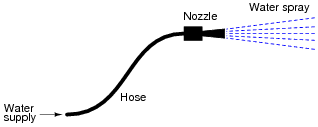
Reveal answerObviously, an unrestrictive nozzle will pass a greater flow rate of water through it, all other factors being equal. In an electric circuit, less resistance will pass a greater flow rate of electrons (current) for a given amount of “pressure” (voltage).
Notes:Water flow is not a perfect analogy for electricity, but is close enough to be useful in basic electricity education. Be prepared to discuss the inadequacies of water as an analogy with your students (i.e. “How come electrons don’t spill out the end of an open wire like water spills out the end of an open hose or pipe?”).
-
Question 5 of 23
Suppose you were to build this circuit and take measurements of current through the resistor and voltage across the resistor:

Recording these numerical values in a table, the results look something like this:
XXXXXXX XXXXXXX Current Voltage 0.22 A 0.66 V 0.47 A 1.42 V 0.85 A 2.54 V 1.05 A 3.16 V 1.50 A 4.51 V 1.80 A 5.41 V 2.00 A 5.99 V 2.51 A 7.49 V Plot these figures on the following graph:
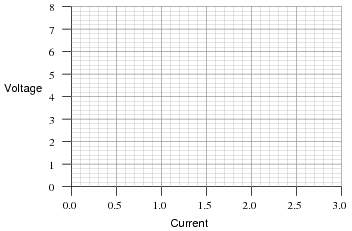
What mathematical relationship do you see between voltage and current in this simple circuit?
Reveal answerThis is an example of a linear function: where the plot describing the data set traces a straight line on a graph. From this line, and also from the numerical figures, you should be able to discern a constant ratio between voltage and current.
Notes:The raw data figures were made intentionally “noisy” in this problem to simulate the types of measurement errors encountered in real life. One tool which helps overcome interpretational problems resulting from noise like this is graphing. Even with noise present, the linearity of the function is quite clearly revealed.
Your students should learn to make graphs as tools for their own understanding of data. When relationships between numbers are represented in graphical form, it lends another mode of expression to the data, helping people to apprehend patterns easier than by reviewing rows and columns of numbers.
-
Question 6 of 23
Explain, step by step, how to calculate the amount of current (I) that will go through the resistor in this circuit:
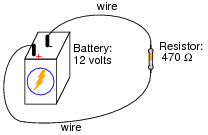
Reveal answerResistor current = 0.02553 amps, or 25.53 milliamps (mA).
Notes:Just a simple Ohm’s Law calculation here - no tricks! The point of this question, however, is to get students to think about the steps they follow in doing the calculation. Many students simply wish to memorize procedures rather than learn why to do what they need to do to answer such questions. It is your task as the instructor to challenge them beyond memorization, and through to understanding.





The questions are very interesting.